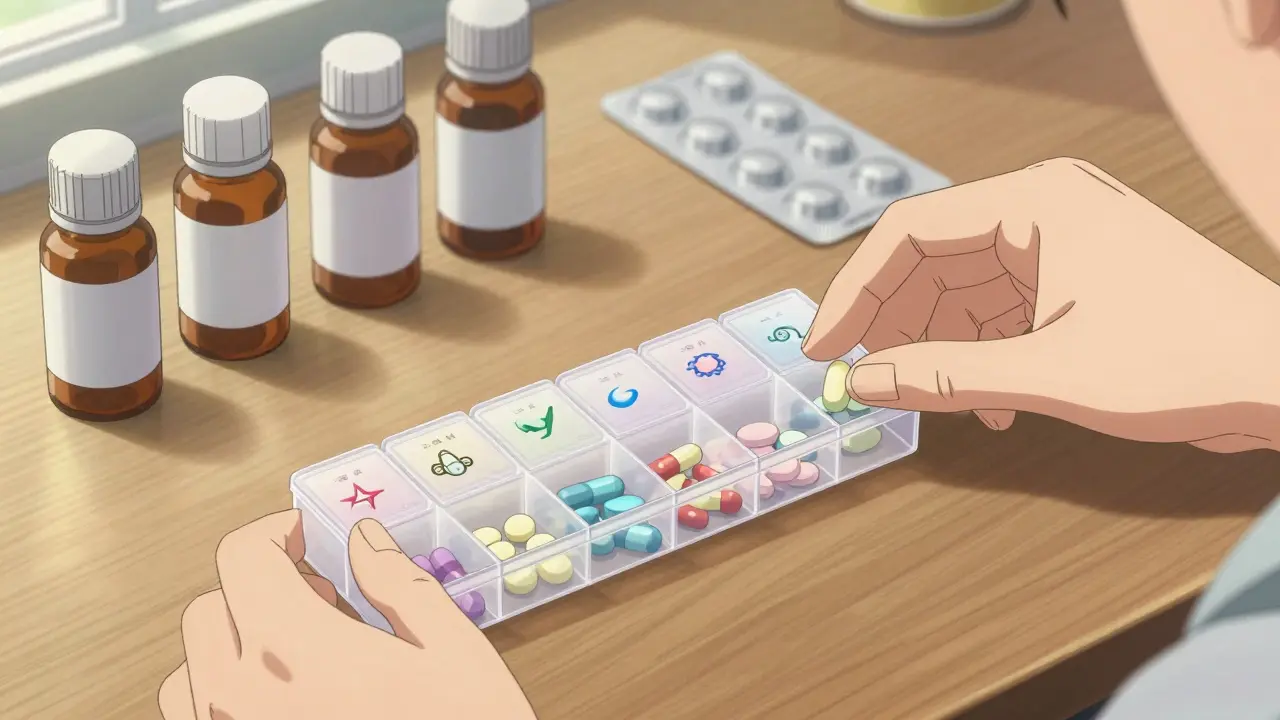
Quick Safety Checklist
- Check with your pharmacist before moving any medication from its original packaging.
- Never store moisture-sensitive drugs (like Pradaxa) in a plastic organizer.
- Clean your organizer weekly using 70% isopropyl alcohol to prevent bacterial growth.
- Use child-resistant locking versions if you have children under 5 in your home.
- Verify your loading process with a second person to avoid double-dosing.
Why We Use Medication Boxes
For many of us, especially those managing chronic conditions, the sheer number of pills can become overwhelming. Whether it's a basic seven-day plastic tray or a high-tech dispenser, these tools are meant to solve a specific problem: forgetfulness. Research shows that using an organizer can boost adherence rates by over 26%, which can be the difference between a stable condition and a hospital visit.
Modern options range from the basic CVS Weekly Pill Organizer , which is a budget-friendly plastic solution, to advanced electronic dispensers that use alarms and locks to prevent mistakes. The primary goal is to remove the "did I take my pill today?" guesswork from your morning routine.
The Danger of the "Plastic Trap"
Here is the part most people miss: not all pills are created equal. Some medications are chemically unstable when exposed to air, light, or humidity. When you move a pill from a manufacturer's foil blister pack or a bottle with a desiccant (those little silica packets), you strip away its primary defense system.
For instance, the FDA has issued explicit warnings about Pradaxa (dabigatran etexilate mesylate). This medication is incredibly sensitive to moisture. If you put it in a standard pill organizer, it can lose up to 37% of its potency within just 30 days. In some cases, patients have experienced serious side effects simply because the drug degraded in a plastic box.
| Medication Type | Safe for Organizers? | Primary Risk | Required Storage |
|---|---|---|---|
| Stable Maintenance Drugs | Yes | Low | Cool, dry place |
| Pradaxa / Dabigatran | No | Potency loss (Moisture) | Original bottle w/ desiccant |
| Effervescent Tablets | No | Degradation | Airtight packaging |
| Nifedipine | No | Light/Humidity sensitivity | Original light-protected container |

Avoiding Common Loading Mistakes
Filling your box for the week might seem like a mindless chore, but it's actually a critical clinical step. A significant number of medication errors occur during the loading process. A simple distraction-a phone call or a knock at the door-can lead to a "double dose" or a missed day.
To stay safe, treat your loading session like a professional protocol. First, wash your hands with antimicrobial soap for 30 seconds. Clean your counter with 70% isopropyl alcohol to keep the environment sterile. Most importantly, don't do it alone if you can help it. Having a spouse, friend, or nurse double-check your compartments against the prescription labels can prevent a dangerous mistake, such as accidentally putting two doses of a diabetes medication in one slot, which could lead to sudden hypoglycemia.
Hygiene and Contamination Risks
We often think of pill boxes as "clean" because they hold medicine, but plastic is porous. Over time, residue from crushed pills, dust, and skin oils build up. In healthcare settings, studies have found bacterial contamination-including Staphylococcus aureus-in a surprising number of pillboxes.
You shouldn't just rinse your organizer with water. To truly sanitize it, wipe the compartments daily with rubbing alcohol. If your model is dishwasher-safe, run it through a "sanitize" cycle once a week. If you notice the plastic becoming cloudy, cracked, or sticky, toss it and get a new one. The cost of a replacement is negligible compared to the risk of a contaminated dose.

Choosing the Right Organizer for Your Needs
Not every box fits every person. If you're only taking one pill a day, a simple weekly tray is fine. However, if you have a complex regimen with morning, noon, and night doses, you need a compartmentalized system to avoid confusion.
For those who struggle with technology or have vision impairment, consider organizers with large-print labels or color-coded sections. If you live in a house with curious toddlers, a standard plastic box is a hazard. You'll need a system with a locking mechanism, such as the Hero Health dispenser, which requires a password to access the medication. While electronic versions have a steeper learning curve-especially for users over 75-the peace of mind provided by automatic reminders and locked lids is often worth the effort.
The Role of the Pharmacist
Before you buy a box, have a five-minute conversation with your pharmacist. They can tell you exactly which of your meds are "standing medications" (safe for organizers) and which must stay in their original foil or bottles. This is especially critical if you are on five or more different medications. A pharmacist can help you create a reconciliation list, ensuring that your organizer doesn't accidentally become a source of pharmaceutical instability.
Can I put all my medications in a weekly pill box?
No. Many medications, such as those that are moisture-sensitive (e.g., Pradaxa) or light-sensitive (e.g., Nifedipine), must remain in their original pharmaceutical packaging to maintain potency. Always check with a professional before transferring medications.
How often should I clean my pill organizer?
You should wipe your organizer daily with 70% isopropyl alcohol and perform a deep clean (such as a dishwasher sanitize cycle) once a week to prevent bacterial contamination.
Are electronic pill dispensers better than plastic ones?
Electronic dispensers are superior for people who forget doses or need child-resistant locking mechanisms. However, they are more expensive and have a higher learning curve for elderly users compared to simple plastic trays.
What should I do if a lid pops open during travel?
If a lid opens and pills mix, do not guess which pill is which. If you cannot identify them with 100% certainty, discard the mixed pills and contact your pharmacist for replacements. Safety is more important than the cost of a few lost tablets.
How do I prevent loading errors?
Minimize distractions during the filling process. Use a clean surface, wash your hands, and ideally have a second person verify the medications against the prescription labels before closing the lids.
Next Steps and Troubleshooting
If you're just starting out, begin by listing every medication you take. Mark them as "Original Bottle" or "Organizer" after consulting your pharmacist. If you find yourself still missing doses despite using a box, it might be time to upgrade to an electronic system with audible alerts.
For caregivers, the best approach is to take over the loading process entirely. Use a checklist to mark off each medication as it is placed in the box. If you notice your loved one is confused by the multiple compartments, try using a color-coded system (e.g., yellow for morning, blue for evening) to make the routine more intuitive.