
When you’re on antibiotics, your body needs every bit of the drug to work. But what you eat - especially dairy - can stop it cold. It’s not just a myth. It’s chemistry. Calcium in milk, yogurt, and cheese binds to certain antibiotics, forming a hard, insoluble lump that your gut can’t absorb. That means the medicine never makes it into your bloodstream where it’s supposed to fight the infection. And if the antibiotic doesn’t reach the right level? The infection doesn’t go away. It gets worse. And worse still - it can lead to antibiotic resistance.
Which Antibiotics Are Affected?
Not all antibiotics play nice with dairy. The big ones are tetracyclines and fluoroquinolones. Tetracyclines include tetracycline, doxycycline, and minocycline. Fluoroquinolones include ciprofloxacin, levofloxacin, and moxifloxacin. These are commonly prescribed for urinary tract infections, sinus infections, Lyme disease, and even acne. If you’re on one of these, your breakfast toast with butter and milk could be sabotaging your treatment.Why these two? Because their chemical structure grabs onto calcium like a magnet. Calcium is everywhere in dairy - milk has about 300 mg per cup, yogurt has even more, and hard cheeses can have over 200 mg per ounce. When calcium and the antibiotic meet in your stomach, they lock together. That complex can’t pass through the intestinal wall. The result? Up to 92% less antibiotic in your blood. A 2022 study in the Journal of Rawal Academy of Sciences showed yogurt cut ciprofloxacin absorption by 92%. Milk still knocked it down by 70%. That’s not a small drop. That’s treatment failure territory.
Why Do Some Antibiotics Escape This Problem?
Penicillins like amoxicillin, macrolides like azithromycin, and cephalosporins like cephalexin? They don’t care about calcium. You can eat your yogurt with those. No problem. Why? Their molecules don’t bind to calcium the same way. They’re built differently. That’s why your doctor might pick one over the other - not just for the bug you have, but also for your lifestyle. If you drink milk with every meal, a penicillin might be a smarter choice than ciprofloxacin.Even within the tetracycline family, there’s a difference. Older tetracycline has a much stronger reaction with calcium than doxycycline. That’s why some doctors say doxycycline is a bit more forgiving. But don’t be fooled. Just because it’s less sensitive doesn’t mean it’s safe. A 2022 GoodRx guide still recommends waiting at least one hour before or two hours after dairy. Skipping that window? You’re risking your recovery.
Timing Isn’t Optional - It’s the Rule
This isn’t about being careful. It’s about exact timing. You can’t just space it out vaguely. You need a schedule.- For tetracyclines: Take the pill at least 1 hour before eating dairy, or wait 2 hours after.
- For fluoroquinolones like ciprofloxacin: Take it 2 hours before dairy, and wait 4 to 6 hours after. Some guidelines say even 8 hours if you’re eating a big dairy-heavy meal.
Why the difference? Fluoroquinolones bind even more tightly to calcium than tetracyclines. And the longer they sit together, the more they stick. A 2022 study from the American Pharmacists Association found that giving ciprofloxacin just 2 hours after yogurt still cut absorption by 50%. That’s not enough. You need 4 to 6 hours to let the calcium clear out of your gut.
Real-life challenge? If you take your antibiotic twice a day - say, 8 a.m. and 8 p.m. - and you eat dairy at breakfast and dinner, you’re stuck. Solution? Shift your meals. Take your morning pill at 7 a.m., eat breakfast at 9 a.m. Take your night pill at 10 p.m., have yogurt at 6 p.m. It’s not ideal, but it works. Many patients who’ve had recurring infections say this timing shift was the only thing that finally cleared their symptoms.
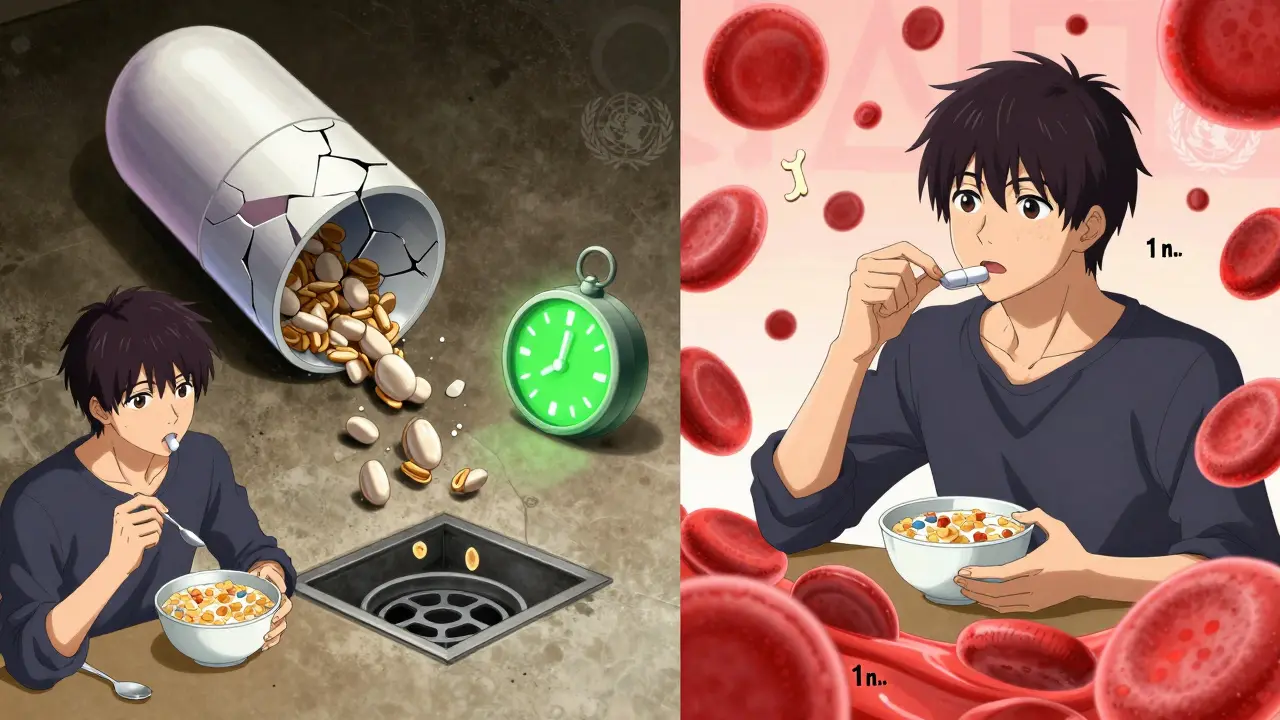
It’s Not Just Milk
People think it’s only dairy. It’s not. Calcium-fortified orange juice? Same problem. Almond milk with added calcium? Same. Soy milk with calcium? Same. Even some breakfast cereals are fortified with calcium. One patient on Reddit shared how her UTI kept coming back - until she realized she was taking ciprofloxacin with her calcium-fortified oatmeal. No dairy. Still ruined the absorption.Calcium supplements? Even worse. A single 500 mg calcium pill can cause the same drop in antibiotic levels as a glass of milk. If you’re on a calcium supplement for bone health, talk to your pharmacist. They’ll tell you to take it at least 4 hours apart from your antibiotic. Don’t assume your doctor told you. Most don’t. A 2022 survey by the American Society of Health-System Pharmacists found 43% of patients got no timing instructions at all.
What Happens When You Ignore This?
You don’t just feel worse. You make things worse for everyone.If the antibiotic doesn’t reach effective levels, the bacteria don’t die. They survive. And they adapt. That’s how antibiotic resistance starts. The WHO estimates that improper timing with dairy or calcium supplements contributes to 5-10% of community-based resistance cases. That means every time you skip the timing rule, you’re not just risking your own health - you’re helping create superbugs that won’t respond to treatment in the future.
And the consequences aren’t theoretical. Dr. Sarah Thompson at Johns Hopkins told Medscape about multiple patients with stubborn UTIs. All of them were taking ciprofloxacin with breakfast - cereal, milk, yogurt. Once they changed their routine, the infections cleared within days. No new prescription. No stronger drug. Just timing.
Patients who follow the rules report near-perfect success. A 2023 study in the Journal of Patient Experience showed 98% of people who waited the full 2-6 hours had their infection fully resolved. Those who didn’t? Only 72% got better. That’s a 26-point gap. One simple habit change. That’s the difference between healing and relapse.

What’s Changing? What’s Next?
The FDA updated labeling rules in January 2023. Now, every box of doxycycline or ciprofloxacin must clearly say when to avoid dairy. That’s new. In the past, instructions were buried in tiny print. Now, it’s front and center.Apps like Medisafe and MyMeds now alert you if you enter an antibiotic that clashes with dairy. You’ll get a push notification: “Don’t have yogurt for 4 hours.” That’s helping. Patient awareness has jumped from 35% in 2018 to 52% in 2023. But we’re still not there.
Researchers are working on new versions of tetracyclines that won’t bind to calcium. Early trials show promise. But don’t hold your breath. These won’t be available until at least 2026. Until then, the only reliable fix is time. Wait. Don’t guess. Don’t hope. Wait.
What Should You Do?
1. Check your antibiotic. Is it a tetracycline or fluoroquinolone? Look at the name. If it ends in “-cycline” or “-floxacin,” you’ve got a problem. 2. Read the label. The box will say “Avoid dairy products.” Don’t ignore it. 3. Plan your meals. Take your pill on an empty stomach. Wait 1-2 hours before eating anything, especially dairy. Wait 4-6 hours after your pill before having yogurt, milk, or calcium-fortified foods. 4. Ask your pharmacist. They know the timing better than most doctors. They see this every day. Ask: “How long do I need to wait after this pill before I can have milk or yogurt?” 5. Track your intake. Use a simple note on your phone: “Took pill at 7 a.m. - no dairy until 9 a.m.” It’s not complicated. But it’s life-changing.This isn’t about being perfect. It’s about being smart. You’re taking antibiotics because you’re sick. Don’t let your breakfast undo your treatment. Timing matters. Not a little. Not maybe. It matters - completely.






Susannah Green
January 22, 2026 AT 11:58Oh my god, I had no idea calcium ruined antibiotics! I take doxycycline and drink almond milk with my cereal every morning-no wonder my UTI kept coming back. I just switched to oatmeal with water and my symptoms cleared in 48 hours. This post saved my life.
Lana Kabulova
January 23, 2026 AT 16:39Wow so you're telling me my 500mg calcium pill at lunch was sabotaging my cipro? No wonder I was still feverish after 5 days. I thought doctors just liked to scare people. Turns out I'm the dumb one. Thanks for the wake-up call.
Andrew Smirnykh
January 25, 2026 AT 15:57It’s fascinating how a simple chemical interaction-calcium binding to tetracycline-can have such profound clinical consequences. The body operates on molecular precision, yet we treat medication like a suggestion rather than a protocol. This is a quiet tragedy of modern self-medication culture.
Rob Sims
January 27, 2026 AT 09:48So let me get this straight-you’re telling people to rearrange their entire life because a pill doesn’t like milk? What’s next? No breathing near the antibiotic? I’ve been taking cipro with yogurt for years and I’m fine. Maybe the real problem is people who think science is a checklist.
Lauren Wall
January 27, 2026 AT 10:31You’re not ‘fine.’ You’re just lucky. And now you’re part of the problem.
Liberty C
January 28, 2026 AT 16:53Oh, so now we’re supposed to be pharmacists? I’m not a chemist, I’m a human being who likes yogurt. The system failed me-pharmacies don’t explain this, doctors don’t care, and now I’m supposed to feel guilty for wanting breakfast? This is medical gaslighting dressed up as ‘advice.’
shivani acharya
January 29, 2026 AT 07:14And who benefits from this? Big Pharma. They know you’ll take the pill wrong, get worse, come back for a stronger one, then another, then another. They make billions off your confusion. And now they’ve slapped a label on the box so you think they care. Wake up. This is a profit-driven distraction. They don’t want you healed-they want you dependent.
arun mehta
January 29, 2026 AT 09:43This is truly eye-opening 🙏 I come from a culture where milk is part of every meal-breakfast, lunch, dinner. I’ve been on doxycycline for acne and didn’t know this. Now I take it at 6 AM with water, and eat dairy at 8 PM. My skin is clearing up! Thank you for sharing this wisdom 🌿
Chiraghuddin Qureshi
January 29, 2026 AT 10:54Same here! In India, we drink lassi with every meal. I thought it was just my body being weak. Now I take my pills before my morning chai and wait till after dinner for yogurt. No more infections. Small change, big difference. 🙏
Patrick Roth
January 30, 2026 AT 18:11Wait, so you’re telling me the entire medical establishment has been lying about this? That the FDA only updated labels in 2023 because someone finally bothered to check? I’ve been taking cipro with cheese for 12 years. I’m not a lab rat. This feels like fearmongering wrapped in a scientific bow.
Jasmine Bryant
January 31, 2026 AT 20:49i just relized i took my azithromycin with a smoothie that had yogurt in it… wait is that bad? i think i read somewhere it was ok? i’m so confused now
Dawson Taylor
February 2, 2026 AT 10:44There is a quiet dignity in precision. The body does not negotiate. It does not forgive. It does not care if you’re busy, tired, or hungry. It simply reacts. When calcium and ciprofloxacin meet, they form a compound that cannot be absorbed. That is not opinion. That is chemistry. To ignore it is not rebellion-it is ignorance masquerading as autonomy. We owe it to ourselves, and to the future of medicine, to honor the science-not the convenience.