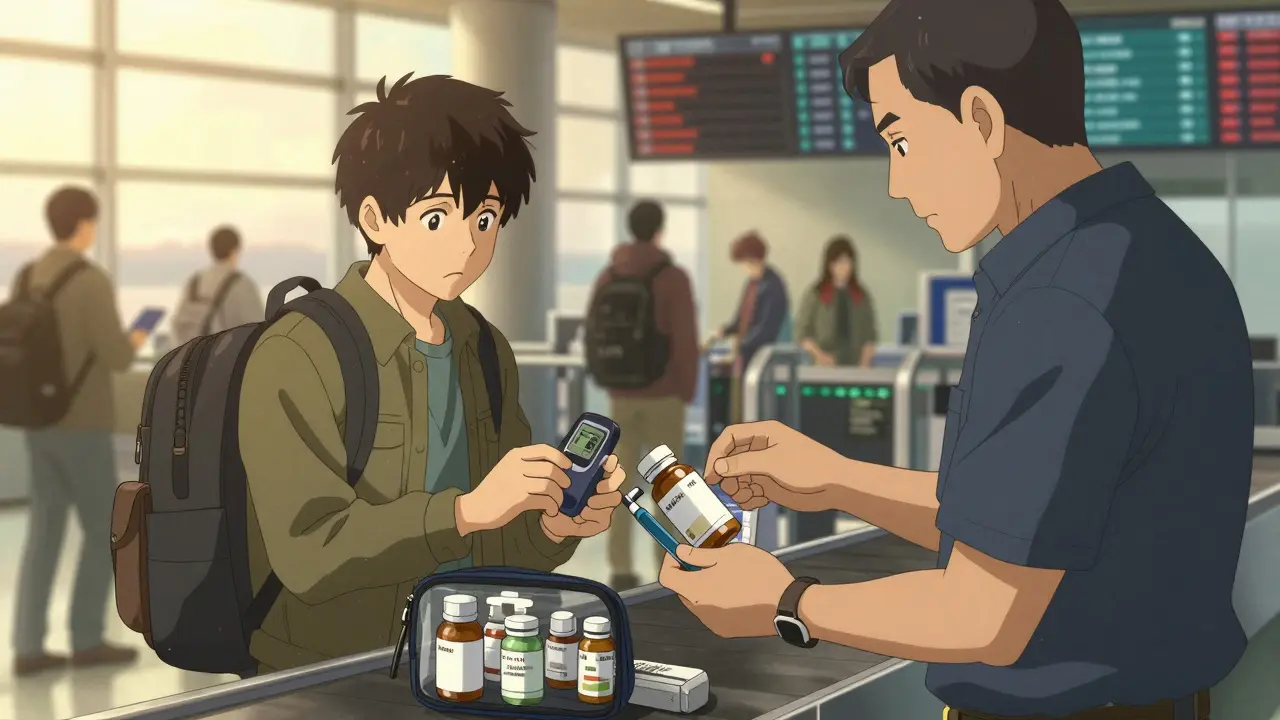
Picture this: you’re at security, backpack on the belt, meds in your carry-on, and the TSA agent stops you. Not because you’re carrying something suspicious-but because your pill bottle has no label. Or your insulin pen is in a checked bag. Or you forgot that alprazolam is illegal in Thailand. This isn’t rare. It happens to thousands of travelers every year, and the consequences can be serious: confiscated meds, missed flights, even arrest.
Traveling with medications isn’t just about packing a pill organizer. It’s about understanding rules that change by country, airport, and even airline. And with more people traveling with chronic conditions-like diabetes, epilepsy, or depression-the stakes are higher than ever. In 2024, over 14% of air passengers carried prescription meds. That’s one in seven. And 22% of those travelers are managing long-term conditions that can’t afford interruption.
What You Can and Can’t Bring Through Security
The TSA allows all medications in carry-on luggage-solid pills, liquids, injections, even medical devices like insulin pumps. But there’s a catch: how you pack them matters. If your meds are in unlabeled bottles, you’re asking for trouble. TSA officers don’t have time to guess what’s in a random vial. They rely on labels to verify legitimacy. In fact, travelers with original pharmacy containers see inspection delays drop by 63% compared to those without.
Liquid medications over 3.4 ounces (100ml) are allowed if they’re medically necessary. You don’t need to put them in the quart-sized bag. Just declare them at the checkpoint. The same goes for syringes, glucometers, and nebulizers. No need to hide them. In fact, hiding them raises suspicion. The TSA’s Cares program (a voluntary service for travelers with medical needs) lets you request a private screening or a sunflower lanyard to signal you need extra help. Since its rollout, processing time for medication carriers dropped by 41%.
Electronic devices with lithium batteries? Those go in carry-on only. Insulin pumps, portable oxygen concentrators, and CPAP machines all contain batteries that can’t go in checked luggage. FAA rules say power banks for medical devices can’t exceed 100 watt-hours without airline approval. Most travel-sized ones are under 50-so you’re fine. But if you’re bringing a backup battery, keep it with you.
International Rules Are a Minefield
What’s legal in Sydney or New York might be a felony in Tokyo or Dubai. The International Narcotics Control Board (INCB) tracks rules in 193 countries. And they update them constantly. In 2025 alone, 47% of countries changed their medication policies.
Some surprises:
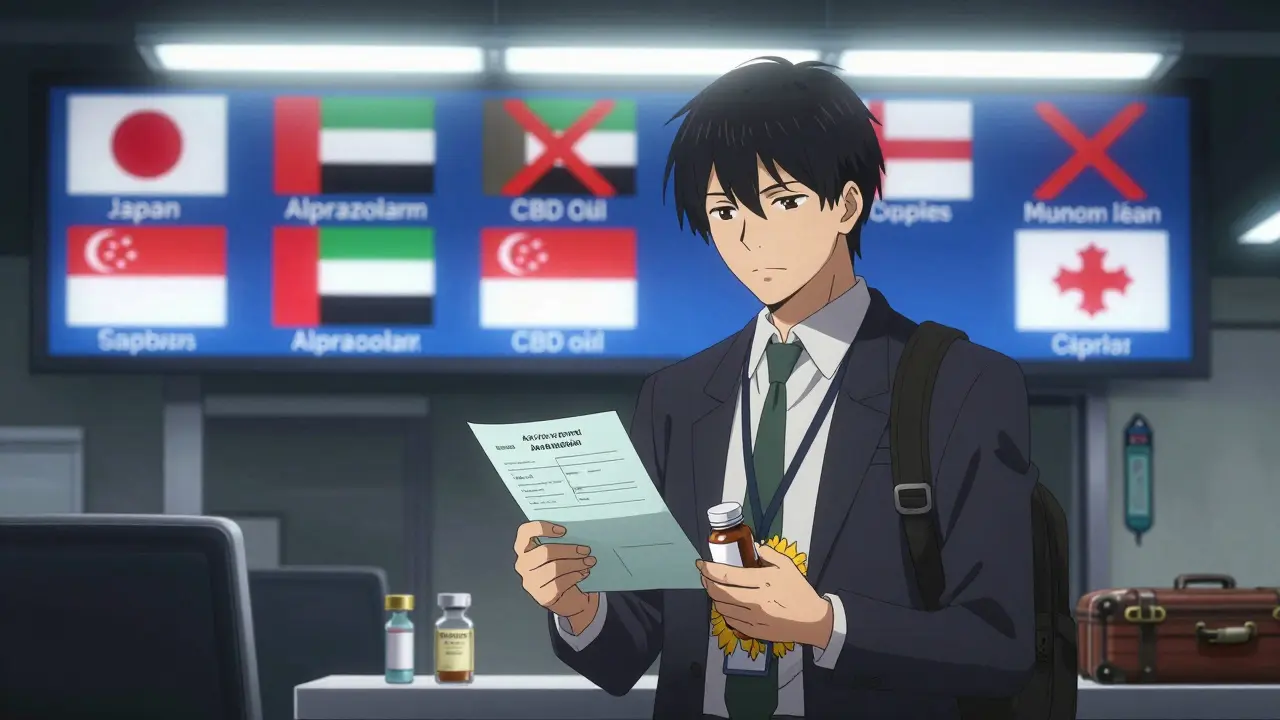
- Japan bans anything with pseudoephedrine-so cold meds like Sudafed are confiscated.
- Thailand requires prior approval for benzodiazepines like Xanax or Valium. Even with a prescription, you’ll need paperwork.
- UAE bans all opioids. Oxycodone, hydrocodone, codeine? Not allowed. Not even with a doctor’s note.
- France and Sweden ban Adderall and Vyvanse completely. No exceptions.
- Singapore and Dubai ban CBD products-even those with 0% THC. That includes gummies, oils, and creams labeled as “hemp-derived.”
The CDC’s Yellow Book 2025 lists five high-risk medications: hydrocodone, oxycodone, alprazolam, diazepam, and zolpidem. These are restricted in nearly 30% of countries. If you’re taking any of these, check the destination’s embassy website before you book your flight. Don’t rely on Google. Embassy sites are the most reliable source.
Pro tip: Print a copy of your doctor’s letter in English. Even if your destination doesn’t require it, having it ready can save hours at customs. The letter should include: your name, medication names and dosages, diagnosis, and that the meds are for personal use. Some countries require translations. Others don’t. But if you have it, you’re covered.
Storage: Keeping Meds Safe in Heat, Cold, and Chaos
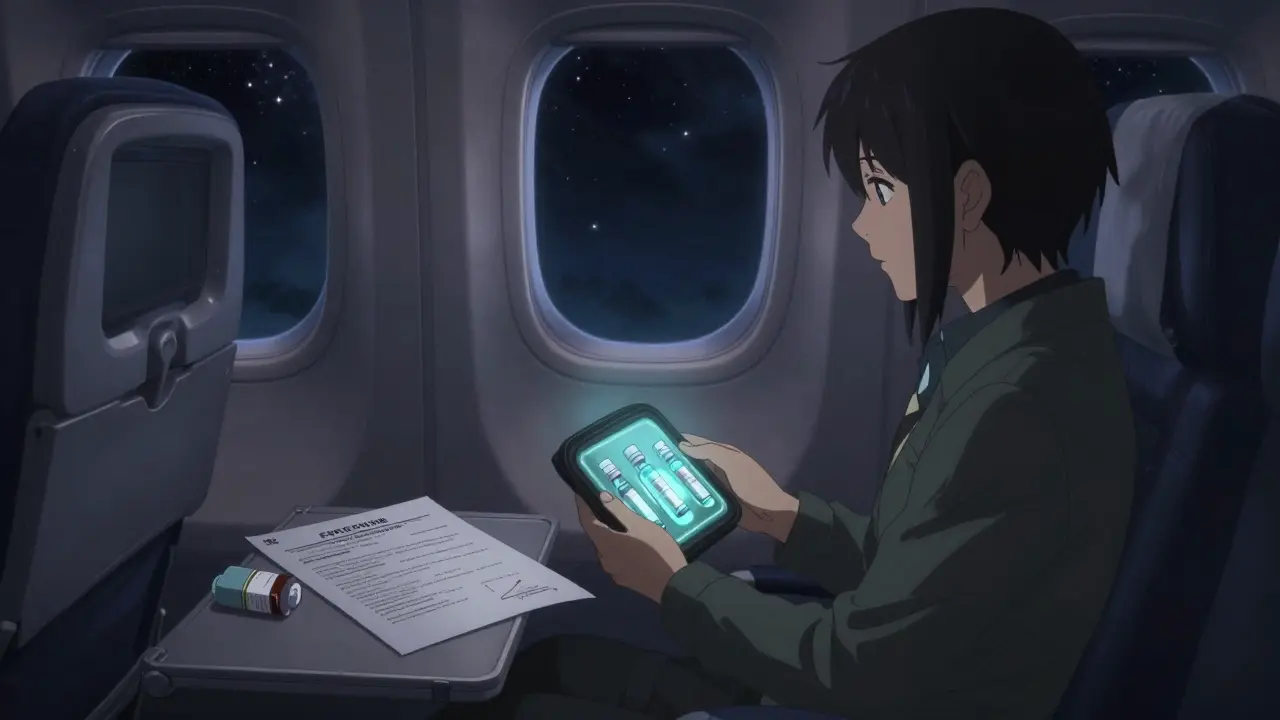
Insulin isn’t just a shot-it’s a temperature-sensitive biologic. The FDA says it must stay between 36°F and 46°F (2°C-8°C). If it gets too hot, it degrades. Too cold? It freezes. Either way, it stops working.
Most travelers think a cooler bag from the grocery store is enough. It’s not. Pharmaceutical-grade cooling wallets are designed for this. They maintain 2°C-8°C for up to 72 hours, even in 40°C heat. A 2025 Diabetes Travel Survey found that 73% of users who used these wallets had zero insulin failures during tropical trips.
For other meds: avoid the car glovebox. Avoid the airplane’s overhead bin. Heat builds up fast. Keep meds with you, in your carry-on. If you’re flying into a cold climate, don’t let your meds freeze. Keep them close to your body-like in a jacket pocket.
And never, ever check your meds. Checked bags get lost. In 2024, 12.7% of international travelers reported medication confiscation or loss. If your meds are in your suitcase and it goes missing? You’re stranded. Distribute your meds across two carry-ons if you can. One for daily use, one as backup. That’s what 92% of chronic condition travelers do to stay safe.
Refills and Extended Stays: What to Do When You’re Out of Pills
The FDA allows you to bring up to a 90-day supply of medication into the U.S. for personal use. That’s fine for vacations. But what if you’re staying six months? Or moving abroad?
If you’re staying longer than 90 days, you can have more medication shipped to you. The FDA allows this-but you need documentation: a copy of your passport, your visa, a doctor’s letter, and a copy of your original prescription in English. Ship it via a recognized courier like DHL or FedEx. Don’t use regular mail. Customs will hold it.
Some countries let you refill prescriptions locally. But only if you have the original bottle and paperwork. In places like Germany or Canada, you can often get a local prescription filled if you show your U.S. bottle and doctor’s note. But in others, like Saudi Arabia or China? Forget it. You need to bring everything with you.
And if you’re running low? Don’t wait until day 28. Plan ahead. If you’re going to be gone 120 days, bring 130 days’ worth. Always have a 10% buffer. You never know when your flight gets delayed, or your bag gets lost.
What to Pack: The Minimalist Medication Travel Kit
Here’s what you actually need:
- Original pharmacy bottles with labels (for every med)
- Doctor’s letter (printed, signed, on letterhead)
- Copy of your prescription (in English)
- Medication cooling wallet (if you need temperature control)
- Small pill organizer for daily doses (keep it separate from original bottles)
- Backup meds in a second carry-on
- Travel-sized syringes or injector pens (if applicable)
- Printed embassy guidelines for your destination
Don’t pack extra meds in checked luggage. Don’t mix pills from different bottles. Don’t rely on airport pharmacies. They won’t have your brand, and they won’t know your dosage.
Pro tip: Take a photo of your original bottles and doctor’s letter on your phone. If you lose the paper copies, you’ve got a backup. And if you’re asked about your meds, stay calm. Say: “These are my prescription medications. Here’s my doctor’s letter.” Most officers just want to know you’re not smuggling drugs.
What to Do If Something Goes Wrong
Let’s say you get stopped. Your meds are questioned. You’re told you can’t bring them in.
First, don’t argue. Stay polite. Ask to speak with a supervisor. Say: “I have documentation. Can I please show it to someone who can help?”
If they confiscate your meds, ask for a receipt. Write down the officer’s badge number. Contact your embassy immediately. U.S. embassies can help with emergency supplies in some cases.
If you’re denied entry because of meds? That’s rare-but it happens. Call your airline. They may be able to rebook you. And if you’re in a country that bans your med? Don’t try to buy it locally unless you’re 100% sure it’s legal. Some black-market versions are fake or dangerous.
The best defense? Preparation. Check the INCB’s country database. Visit your destination’s embassy website. Call them if you’re unsure. Most have travel health sections. They’ll answer your questions.
Can I bring my insulin pump on a plane?
Yes. Insulin pumps and other medical devices with lithium batteries must be carried in your carry-on luggage. Never check them. You can go through security with it on your body. Declare it to the TSA agent. You don’t need to remove it unless asked. Most airports now have trained staff who know how to handle these devices safely.
Is CBD oil allowed when traveling internationally?
In the U.S., TSA allows CBD oil with less than 0.3% THC. But internationally, 29 countries-including Singapore, Dubai, Japan, and South Korea-ban all CBD products, even if they contain zero THC. Always check your destination’s laws. Don’t assume it’s legal just because it’s legal at home.
What if my medication isn’t available in the country I’m visiting?
If your medication isn’t available locally, you must bring enough for your entire trip plus a 10% buffer. Some countries allow you to refill with a local doctor if you have your original prescription and bottle. But many don’t. Never rely on finding your exact brand abroad. Always plan ahead.
Do I need a doctor’s letter for every medication?
You don’t always need one-but you should have one for every international trip. The CDC recommends it for all international travel. A single letter listing all your meds, dosages, and diagnosis is enough. It doesn’t need to be notarized, but it must be signed and on official letterhead.
Can I get a refill while abroad if I run out?
It depends. In countries like Canada, Germany, or Australia, you can often get a local prescription filled if you show your original bottle and doctor’s letter. In others, like China or Saudi Arabia, you cannot. Always research ahead. If you’re staying long-term, arrange for mail shipments with proper documentation before you leave.
If you’re planning a trip and have meds, start planning 6 weeks out. Check the embassy. Print the letter. Buy the cooling wallet. Pack your backups. This isn’t overkill-it’s insurance. Because when you’re on the other side of the world, and your insulin stops working? There’s no pharmacy open at 2 a.m. That’s why smart travelers don’t leave it to chance.




Vinaypriy Wane
January 14, 2026 AT 09:21Let me just say this: if you're flying with insulin and don't have a pharmaceutical-grade cooling wallet, you're not just being careless-you're risking your life. I've seen people use Ziploc bags with ice packs. That's not a strategy. That's a death sentence waiting for a 14-hour flight over the desert. The 73% success rate from the 2025 Diabetes Travel Survey isn't a coincidence-it's science. Stop treating your medication like a snack you forgot in the glovebox.
laura Drever
January 14, 2026 AT 18:00lol at the TSA ‘Cares’ program. Like they care. I got pulled aside for my antidepressants and the officer asked if I was ‘trying to hide something’. I showed my bottle. He shrugged. No lanyard. No help. Just a 20-minute delay and a free anxiety attack. This guide is overkill. Most people just get lucky.
Jesse Ibarra
January 15, 2026 AT 15:11Of course Thailand bans alprazolam. Because nothing says ‘civilized society’ like criminalizing mental health. Meanwhile, the UAE bans opioids but lets you buy camel milk lattes with 14 grams of sugar. This isn’t regulation-it’s moral panic dressed up as policy. And the CDC’s Yellow Book? It’s a glorified list of ‘drugs we don’t like’. Who authorized these bureaucrats to play god with my prescriptions? I’m not a criminal because I need Xanax to sleep. I’m a patient. And I’m tired of being treated like a drug dealer.
Kimberly Mitchell
January 16, 2026 AT 08:43The entire premise of this article assumes that every traveler has access to original pharmacy bottles, printed doctor’s letters, and the time to research 193 countries’ drug laws. What about the undocumented? The underinsured? The people who get their meds through a $5 coupon at Walmart and have no idea what’s in the bottle? This isn’t a guide-it’s a luxury checklist for the privileged. And the ‘pro tip’ about photos on your phone? That’s not preparation. That’s damage control after you’ve already failed.
James Castner
January 17, 2026 AT 20:25There’s a deeper philosophical layer here that most readers are missing. The real crisis isn’t the lack of labeling on pill bottles-it’s the systemic alienation of the chronically ill from global mobility. We’ve constructed a world where your right to exist in another country is contingent upon bureaucratic compliance with pharmaceutical norms that were never designed for human beings. The TSA’s Cares program? A Band-Aid on a hemorrhage. The cooling wallet? A technological palliative. But the core issue remains: why should a diabetic’s ability to breathe, move, or dream be subject to the whims of customs agents who’ve never read a single line of their own country’s pharmacopeia? We don’t need more rules-we need a reimagining of human dignity as a non-negotiable travel right.
lucy cooke
January 19, 2026 AT 02:58Oh my god. I just got back from Bali. I had my CBD oil in my purse. Didn’t even declare it. No one cared. And now I’m reading this and realizing I almost got arrested for a $12 tincture? I’m traumatized. I think I need a therapist. And a new passport. And maybe a new life. This article just rewired my entire identity. I’m not a traveler anymore. I’m a walking pharmaceutical liability.
Diana Campos Ortiz
January 19, 2026 AT 05:27My mom has type 1 diabetes and travels every year to see her grandkids. She uses the cooling wallet, carries her letter, and always packs backups. She’s not ‘overprepared’-she’s just smart. I used to think this stuff was paranoia. Now I get it. One missed dose and she’s in the hospital. This isn’t about rules. It’s about love. And if you think this guide is too much? You haven’t held someone’s hand while they’re hypoglycemic on a foreign airport floor.
Priyanka Kumari
January 20, 2026 AT 14:12Just wanted to add-Germany and Canada will refill your U.S. prescription if you have the original bottle and a doctor’s note, but only if you go to a pharmacy that speaks English. I learned this the hard way in Munich. The first pharmacist told me no. The second one, who’d worked in Toronto, looked at my bottle and said, ‘Ah, yes. This is the same as Glucophage.’ Saved me. So: call ahead. Ask if they know U.S. brands. Don’t just walk in. And bring cash. Insurance doesn’t travel.
Clay .Haeber
January 21, 2026 AT 08:18Wow. So I’m supposed to carry a 10% buffer? A printed embassy guide? A cooling wallet? A doctor’s letter? And a backup in a second carry-on? Next you’ll tell me I need to wear a suit made of insulin-resistant fabric. This isn’t travel advice. It’s a cult initiation. If I have to jump through this many hoops just to take my Adderall to Paris, maybe I should just stay home and meditate. Or become a monk. Or move to Antarctica. At least there, the rules are simple: no one’s there to arrest you.
jefferson fernandes
January 22, 2026 AT 13:34To everyone panicking about CBD or alprazolam: this isn’t about fear. It’s about responsibility. I’m a nurse who’s seen people lose limbs because their insulin degraded in a checked bag. I’ve held the hands of people who got deported because they had a prescription bottle without a label. This isn’t overkill. It’s survival. If you think this is too much, ask yourself: what’s the cost of being wrong? A missed flight? Or a coma in a foreign ER with no one who speaks your language? Don’t be the person who says ‘I didn’t know’-because the world doesn’t care what you didn’t know. It only cares that you didn’t prepare.
Robin Williams
January 24, 2026 AT 10:49Just bring your meds in a Ziploc. Write the name on the bag with a Sharpie. Smile. Say ‘it’s for my grandma’. They don’t care. Most of them are just trying to get through their shift. This whole guide is like telling someone to wear a helmet to buy milk. Chill out. The world’s not out to get you. Just don’t be a dumbass.