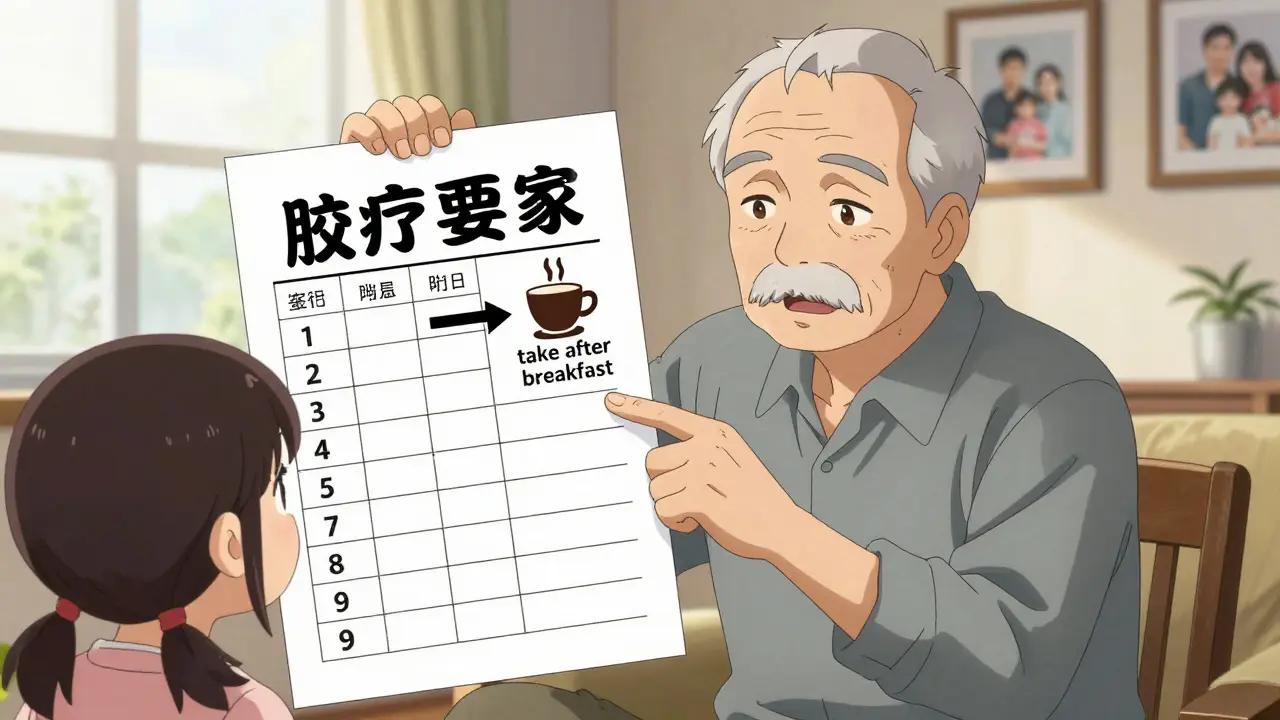
When someone turns 65, their body changes. So do their needs when it comes to understanding health information. Many older adults struggle to read medication labels, follow doctor’s instructions, or make sense of discharge papers after a hospital visit. This isn’t about being slow or careless-it’s about how health information is often written for people who are decades younger. The good news? There are clear, proven ways to fix this. And the right materials can mean the difference between staying healthy and ending up back in the hospital.
Why Standard Health Materials Don’t Work for Seniors
Most brochures, websites, and handouts are written at a 7th to 8th grade reading level. That sounds fine-until you learn that 71% of adults over 60 have trouble reading printed health materials, according to the CDC’s National Assessment of Adult Literacy. Even more concerning: 80% struggle with forms, charts, and numbers. Imagine trying to figure out how many pills to take when the label says ‘take one tablet by mouth twice daily’ but the font is tiny, the words are dense, and the timing isn’t clear. That’s the reality for millions. It’s not just reading. Vision changes. Hearing fades. Memory gets slower. A 2021 study in the Journal of General Internal Medicine found that when materials were rewritten to a 3rd to 5th grade level, comprehension among seniors jumped by 42%. That’s not a small gain. That’s life-changing.What Makes a Good Senior Patient Education Material
Effective materials don’t just simplify words-they rethink how information is presented. Here’s what works:- Font size: 14-point or larger-smaller fonts are unreadable for many seniors with presbyopia or cataracts.
- Clear typefaces-Arial, Verdana, or Helvetica work better than fancy fonts like Times New Roman.
- High contrast-black text on white background, never gray on beige.
- One idea per page-no long paragraphs. Bullet points. Short sentences.
- Visuals over text-a picture of a pill bottle with arrows showing when to take it beats a paragraph about dosing schedules.
- Real-life context-instead of saying ‘take with food,’ say ‘take after breakfast with your toast and coffee.’
Where to Find Trusted Materials
You don’t have to create everything from scratch. Several trusted organizations have already built free, easy-to-use resources:- HealthinAging.org-run by the American Geriatrics Society, this site has over 1,300 free materials on topics like diabetes, heart failure, and fall prevention. All are reviewed by doctors and tested with older adults.
- MedlinePlus Easy-to-Read-the National Library of Medicine offers 217 materials checked with the Health Education Materials Assessment Tool (HEMAT). Search by condition: Alzheimer’s, arthritis, high blood pressure.
- NIA’s Talking With Your Older Patients-a guide for providers, but also useful for families. It includes scripts for explaining treatments in plain language.
- CDC’s Healthy Aging Resources-their 2023 update includes guides on managing multiple medications and using telehealth safely.
How to Use These Materials-The Teach-Back Method
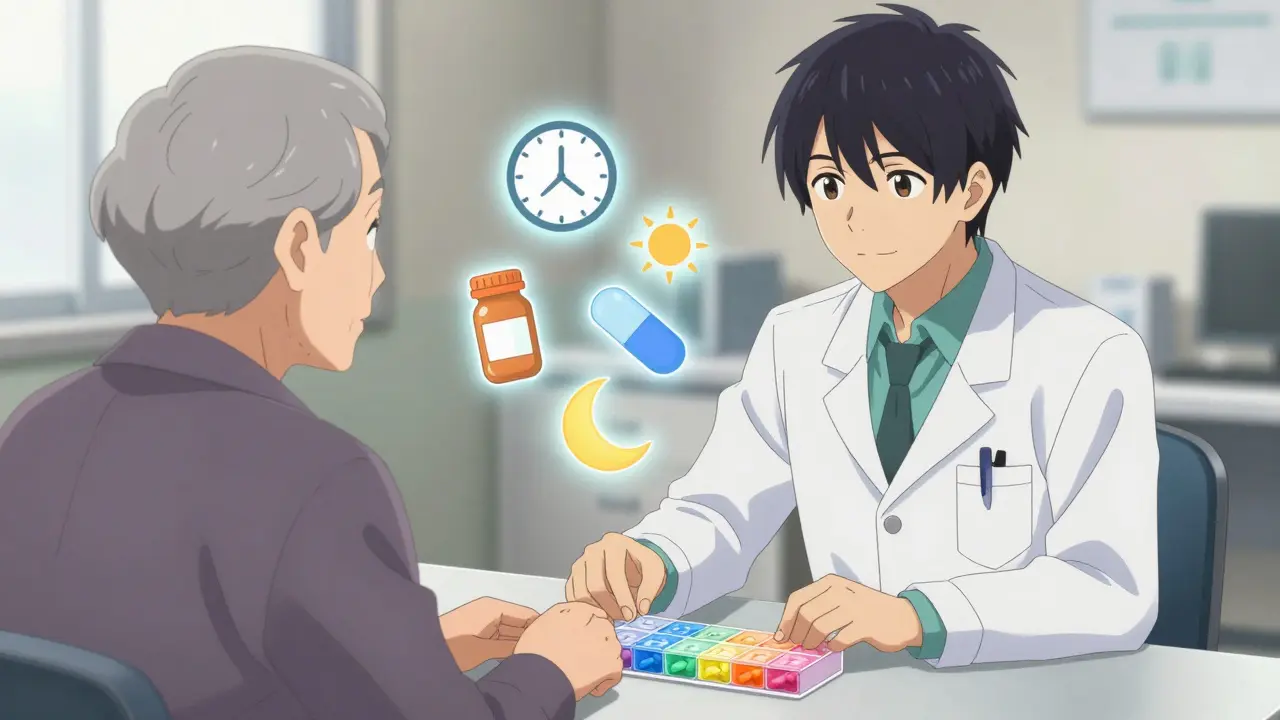
Giving someone a handout isn’t enough. You need to check if they understood it. That’s where the teach-back method comes in. Instead of asking, ‘Do you understand?’-which most people will say yes to, even if they don’t-say:- ‘Can you tell me in your own words how you’ll take this medicine?’
- ‘Show me how you’d set your pill organizer for this week.’
- ‘What would you do if you felt dizzy after taking this pill?’
Why Most Clinics Still Get It Wrong
You’d think with all the evidence, every doctor’s office would be using these tools. But they’re not. A 2023 survey by the American Medical Association found that only 28% of U.S. healthcare systems have fully integrated health literacy practices into their daily routines. Why? Two big reasons:- Staff are overwhelmed-78% of providers say they don’t have time to create or use better materials.
- Funding is tight-65% of community health centers say they can’t afford to design custom materials.
Technology Is Changing the Game
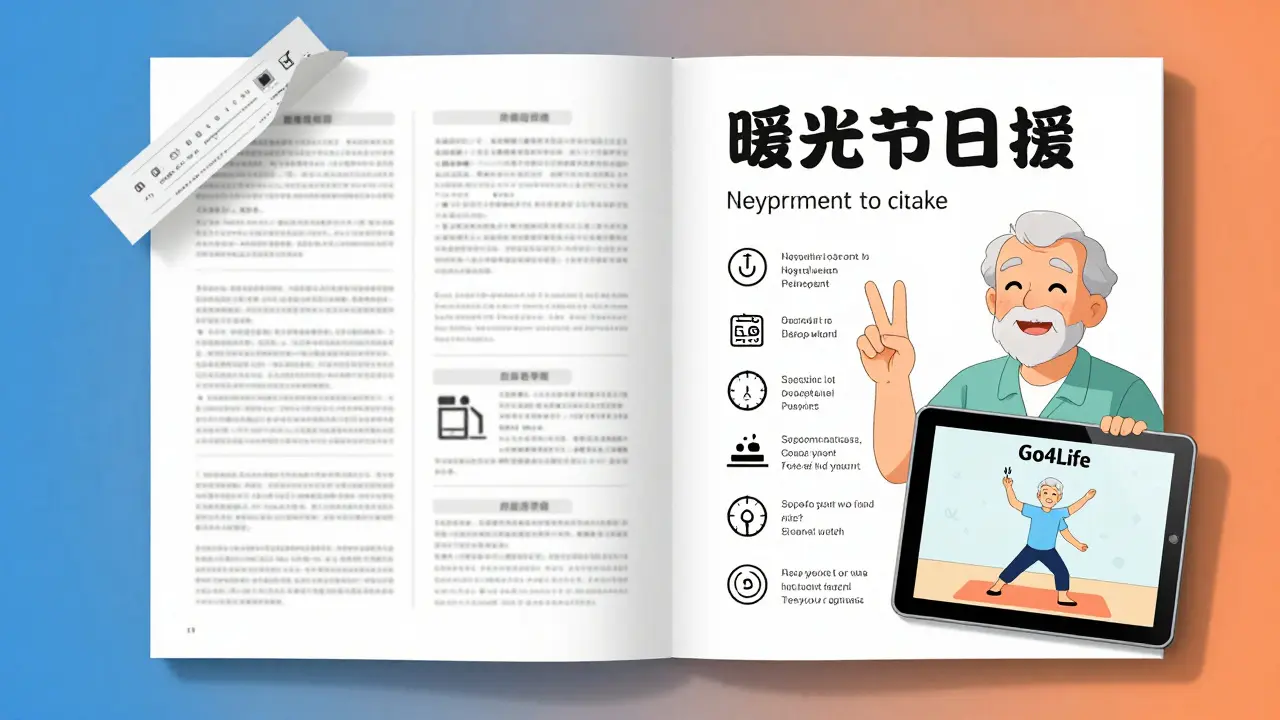
More seniors are using tablets and smartphones now than ever before. In 2023, 68% of adults over 65 used telehealth-up from just 17% in 2019. That’s progress. But digital tools can be confusing. The CDC now says health literacy must include digital literacy. Can they log in? Can they hear the video? Can they tell if the app is telling them to take a pill at 8 a.m. or 8 p.m.? New tools are emerging to help:- NIA’s updated Go4Life program now includes voice-activated exercise guides.
- HealthinAging.org added 47 new resources in 2023, including ones for people with mild memory loss.
- A $4.2 million NIH study is testing AI tools that adjust content based on how fast someone reads or how well they hear.
What Families Can Do Right Now
You don’t need to be a doctor to help. Here’s what you can do today:- Ask the doctor: ‘Can you give me a simple version of this information?’
- Use a highlighter to mark key points on any handout.
- Write down the medicine schedule on a sticky note and put it on the fridge.
- Watch a video together from HealthinAging.org and talk about it.
- Never let them leave a visit without using teach-back.
The Bigger Picture
By 2040, one in five Americans will be over 65. That’s 80 million people. If we keep using the same old materials, we’ll see more confusion, more mistakes, more hospital stays. But if we use simple, clear, visual, tested materials-materials designed for real people, not textbooks-we can change that. We can help seniors stay independent longer. We can reduce fear. We can give them back control. It’s not complicated. It’s just common sense.What reading level should senior patient education materials be written at?
Senior patient education materials should be written at a 3rd to 5th grade reading level. This matches the reading ability of about 20% of U.S. adults, including many older adults. Research shows that materials at this level improve understanding by 42% compared to standard medical materials. Avoid complex terms like ‘hypertension’-use ‘high blood pressure’ instead.
Are there free resources I can use for my elderly parent?
Yes. HealthinAging.org, MedlinePlus Easy-to-Read, and the National Institute on Aging (NIA) offer hundreds of free, tested materials. These include one-page guides on managing diabetes, heart failure, medications, and fall prevention. All are written in plain language, tested with older adults, and available to download or print at no cost.
Why do older adults often not ask questions during doctor visits?
Many older adults don’t ask questions because they feel embarrassed or fear being seen as unintelligent. A 2022 National Council on Aging survey found that 51% of seniors admit to staying silent when confused. Others may have hearing or memory issues that make it hard to follow fast-paced conversations. Creating a calm, patient environment and using teach-back helps reduce this barrier.
How can I tell if a health material is truly easy to read?
Look for the Health Education Materials Assessment Tool (HEMAT) label or check if it comes from trusted sources like the CDC, NIA, or HealthinAging.org. Good materials use large fonts (14-point+), high contrast, short sentences, and visuals. Avoid anything with long paragraphs, medical jargon, or small print. Test it yourself: Can you understand it in under 30 seconds?
Does using better materials really reduce hospital visits?
Yes. A 2022 review by the Agency for Healthcare Research and Quality found that clinics using universal health literacy practices saw a 22% drop in emergency visits among older patients within 18 months. Hospitals that implemented full senior education programs saved $1,842 per patient on readmissions. Clear communication prevents mistakes-and mistakes lead to hospital stays.


Greg Quinn
December 29, 2025 AT 13:47It’s wild how we expect seniors to decode medical jargon like it’s a cryptic crossword puzzle. We design apps for toddlers that are intuitive, but hand them a pill bottle with fine print and call it ‘informed consent.’ The real failure isn’t their memory-it’s our laziness.
What if we treated health info like a user manual for a toaster? You wouldn’t print it in 8-point font and expect someone to read it while squinting. You’d make it big, clear, and visual. Why is this so hard to grasp?
Emma Duquemin
December 31, 2025 AT 02:50OMG YES. I helped my grandma navigate her diabetes plan last year and I swear, it was like translating ancient hieroglyphs. Then I found HealthinAging.org and everything changed. She started using their visual pill charts and now she’s the one teaching the nurses how to explain things. 🙌
And the teach-back method? Absolute GAME CHANGER. She actually said, ‘I feel like I’m finally being heard.’ That’s not just good care-that’s dignity.
Why are we still treating seniors like they’re broken? They’re not. The system is. And we can fix it with a printer, a highlighter, and a little patience. 💪❤️
Kevin Lopez
January 1, 2026 AT 04:433rd to 5th grade level? That’s dumbing down. Medical literacy requires precision. You can’t replace ‘hypertension’ with ‘high blood pressure’ and expect outcomes to improve. It’s not about accessibility-it’s about accuracy. If they can’t handle the terminology, they shouldn’t be managing their own meds.
And teach-back? That’s just time-wasting. Doctors have 12-minute visits. You can’t turn every consult into a therapy session.
Duncan Careless
January 2, 2026 AT 10:09Interesting piece, really is. I’ve seen this first hand with my mum-she’s 78, sharp as a tack, but can’t read the script on her prescriptions. We switched to HealthinAging.org materials and it’s made a world of difference.
Only thing I’d add: sometimes it’s not the text, it’s the *delivery*. My GP just hands it over like a receipt. If they’d sit down, slow down, and say ‘tell me what this means to you’-it’d stick.
Also, typo: ‘m as in Mary’-should be ‘m as in ‘Mary’’? Just sayin’ 😅
Samar Khan
January 2, 2026 AT 20:06Ugh. I hate this. My aunt died because she mixed up her pills. The label said ‘take 1 tab daily’ but the ‘1’ looked like a ‘7’ and she took 7. 💔
And now you’re telling me we have *free* resources and NO ONE USES THEM? 😭
Healthcare is a CRIME against old people. They’re treated like ghosts. I’m so mad I could scream. 🤬
Jasmine Yule
January 4, 2026 AT 06:32Kevin, you’re missing the point. Precision matters-but not when people die because they can’t read it. Accuracy without accessibility is cruelty.
And Emma? You’re right. My mom used to cry because she felt stupid. Now she proudly shows her pill chart to her friends. That’s not just compliance-that’s empowerment.
Also, Duncan? You’re right about delivery. My dad’s doctor never looked him in the eye. Just handed him a pamphlet and said ‘call if you have questions.’
What if we trained nurses to say ‘I’m here to help you understand’ instead of ‘did you read this?’
Alex Ronald
January 5, 2026 AT 06:17I work in a senior center and we started using the NIA’s visual guides last year. No more ‘I forgot what the doctor said.’ We have a weekly ‘Medication Monday’ where we go over the charts together. People laugh, ask questions, and actually remember.
One guy told me, ‘I’ve been taking this pill wrong for three years. I thought ‘twice daily’ meant morning and night. Turns out it was breakfast and dinner.’
It’s not rocket science. Just care.
And yes-free resources exist. Use them. Print them. Tape them to the fridge. It’s that simple.
Teresa Rodriguez leon
January 5, 2026 AT 14:30I used to be a nurse. Saw this every day. Seniors nodding, smiling, saying ‘yes, I understand’-then going home and taking their pills wrong. Or not at all.
The system is broken. Not because they’re old. Because we don’t care enough to fix it.
And yes, I know about the resources. But no one in administration will approve the budget to print them. So they stay online. Where the people who need them most can’t access them.
It’s not ignorance. It’s neglect.
Manan Pandya
January 6, 2026 AT 17:09Excellent summary. I’ve reviewed these materials for our community health outreach in Mumbai. The principles are universal. Even with cultural differences, the core needs remain: clarity, contrast, simplicity.
One addition: audio versions. Many seniors here have better auditory memory than visual. A simple voice recording of the instructions, played through a low-cost device, can be life-saving.
Also, avoid using ‘you’ too much. Some find it accusatory. ‘One should take’ feels less confrontational than ‘you must take.’ Small linguistic shifts matter.
Nicole K.
January 7, 2026 AT 19:09This is why we need mandatory health literacy training for all doctors. If you can’t explain a pill to a 70-year-old, you shouldn’t be licensed. It’s not ‘nice to have’-it’s ethical.
And no, ‘it’s not my job’ is not an excuse. You’re a doctor. Your job is to heal. Not to confuse.
Also, if you’re using Times New Roman? Fire yourself.
Amy Cannon
January 8, 2026 AT 00:07While the intent of this piece is undeniably noble and aligned with the principles of patient-centered care, one must acknowledge the structural impediments that persist within the American healthcare infrastructure, particularly as it pertains to resource allocation, institutional inertia, and the commodification of medical services. The notion that simplifying language equates to improved outcomes is, in theory, laudable; however, the absence of systemic policy reform, coupled with the absence of reimbursement mechanisms for time-intensive educational interventions, renders many of these recommendations aspirational rather than actionable. Furthermore, the reliance on free digital resources presupposes a level of technological fluency and infrastructural access that is not universally present among the aging population, particularly in rural and low-income communities. One might argue that the real issue is not the materials themselves, but the failure of policy to mandate and fund their integration into standard clinical workflows. Until reimbursement models evolve to incentivize health literacy as a core outcome metric-not merely a ‘best practice’-we will continue to see a disjunction between evidence and implementation.
Himanshu Singh
January 8, 2026 AT 10:41Great post! I shared this with my dad’s clinic and they actually printed out the pill charts from HealthinAging.org. He’s been using them for two months now and hasn’t missed a dose. 😊
Also, the teach-back thing? I tried it last week. Asked him to show me how he sets his pill box. He got it right on the first try. Felt so proud.
PS: typo in ‘medications’ - I think you meant ‘medicines’? Just sayin’ 😅