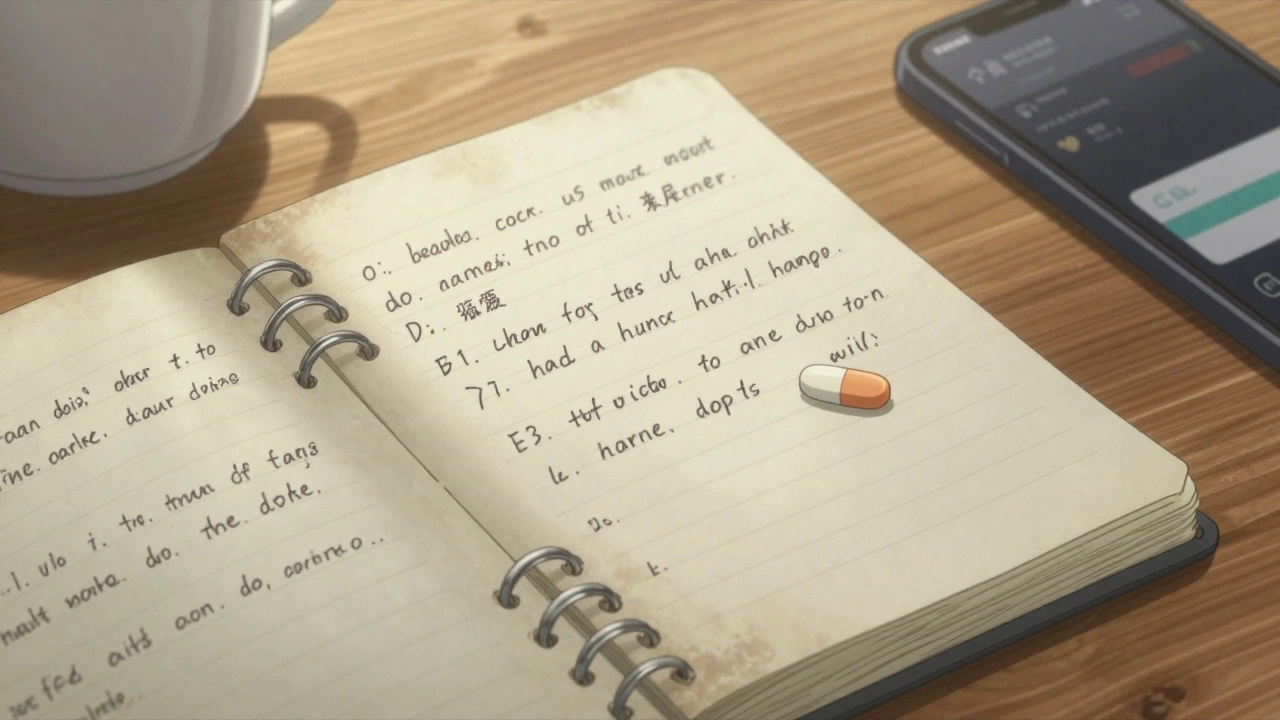
Every year, thousands of people accidentally take too much of a medication-sometimes because they lost track, sometimes because they mixed it with something else, and sometimes because the dose felt different that day. Overdose doesn’t always mean drugs. It can happen with prescription painkillers, sleep aids, anxiety meds, or even over-the-counter pills like acetaminophen if you’re not careful. The good news? A simple medication log can stop most of these mistakes before they happen.
Why a Medication Log Works Better Than Memory
Your brain isn’t built to remember every pill you took, when you took it, or how much you felt after. You might think, “I only took one last night,” but was it 5 mg or 10 mg? Did you take it with alcohol? Did you feel dizzy afterward? Without writing it down, you’re guessing. And guessing with medication can be deadly. A medication log turns guesswork into facts. It’s not about being paranoid-it’s about being safe. Think of it like a car’s odometer. You don’t remember every mile, but you know exactly how far you’ve driven because the car tracks it. Your body deserves the same tracking.What to Write in Your Medication Log
A good log doesn’t need to be fancy. You don’t need an app. A notebook and pen work fine. But it needs these five things for every entry:- Medication name-Use the brand or generic name exactly as it appears on the bottle. Don’t write “pain pill.” Write “oxycodone 5 mg” or “ibuprofen 200 mg.”
- Dose taken-How many pills? How many milligrams? Write it clearly: “1 tablet (10 mg)” not “one.”
- Time taken-Use a 24-hour clock if you can: “14:30” instead of “2:30 PM.” This avoids confusion, especially if you’re taking meds at night.
- Reason for use-Why did you take it? “For back pain,” “trouble sleeping,” “anxiety spike.” This helps you spot patterns.
- Effects or side effects-Did you feel drowsy? Nauseous? Clearer-headed? Did your pain go down by half? Write it. This tells you if the dose is right.
And here’s the extra step most people skip: write down everything else you took that day. Alcohol? Benzodiazepines? Cough syrup? Even herbal teas like kava or valerian root? Mixing medications-even legal ones-can cause dangerous interactions. The CDC says combining opioids with alcohol or benzodiazepines increases overdose risk by up to 40%. Your log should show you what you’re mixing before it’s too late.
How to Start (Even If You’re Not Sure You’ll Stick With It)
The biggest reason people quit logging? They feel overwhelmed. So start small.- Day 1: Just log your most dangerous medication-the one with the highest overdose risk. Maybe it’s your painkiller. Maybe it’s your sleeping pill.
- Day 2: Add the time and effect. Don’t worry about everything else yet.
- Day 3: Add what else you took that day.
After a week, you’ll notice things you didn’t know. Maybe you’re taking your pain pill every 4 hours when the bottle says every 6. Maybe you feel worse after drinking coffee with it. Maybe you took two pills because you thought you missed one-and you didn’t. That’s the power of a log.
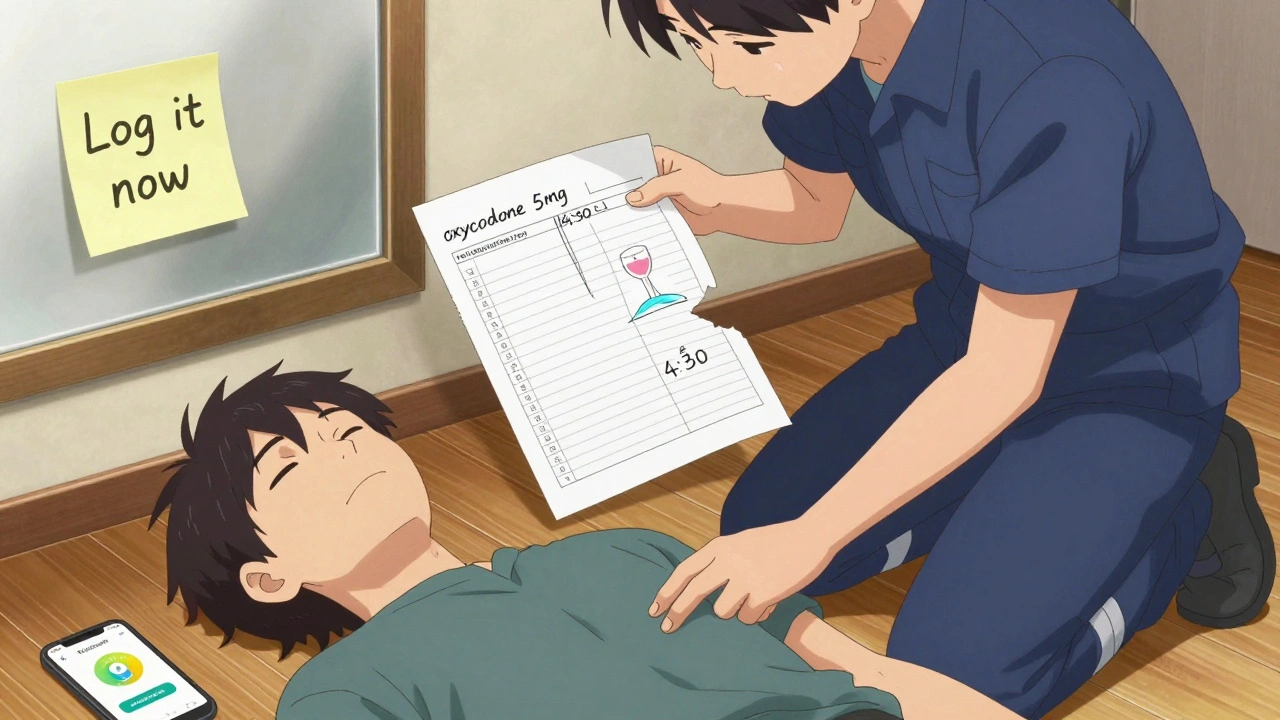
Use a sticky note on your bathroom mirror if you forget. Set a phone alarm labeled “Log it now.” If you miss a day, don’t quit. Just start again tomorrow. Consistency beats perfection.
Digital vs. Paper: Which One Works Better?
There’s no single right answer. It’s about what you’ll actually use.Paper logs are simple, private, and don’t need batteries. You can keep one in your wallet, purse, or next to your meds. You can even draw a quick chart with boxes for each day. Many people in harm reduction programs use these because they’re easy to show a doctor or a friend in an emergency.
Digital logs can remind you to take your pills and log them at the same time. Apps like Medisafe, MyTherapy, or even a simple Notes app on your phone work. Some let you scan your pill bottle barcode to auto-fill the name. But they can fail-phone dies, app crashes, you forget to open it. If you use digital, make sure you can access it offline.
Best option? Keep a paper log as your main one, and use your phone as a backup. If you’re ever unconscious or in an emergency, a first responder can’t open your phone-but they can read your notebook.
Use Your Log to Spot Danger Signs
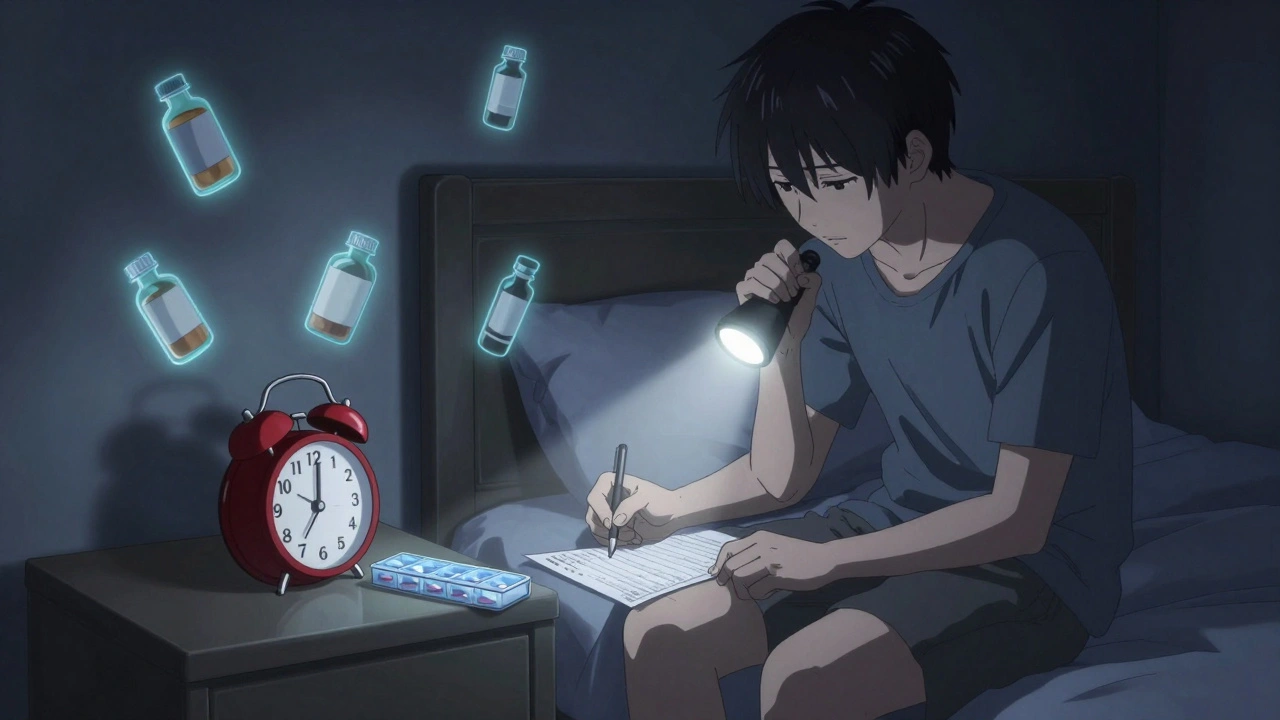
After a few weeks, look back. Ask yourself:- Are you taking more than prescribed? (Even if you “feel like you need it”)
- Are you taking it earlier than scheduled because you’re anxious?
- Do you feel worse after taking it, not better?
- Are you mixing it with alcohol, sleep aids, or muscle relaxers?
- Have you ever taken a pill you didn’t recognize because it looked different?
If you answer yes to any of these, your log is doing its job. It’s not judging you. It’s warning you. And that’s when you call your doctor-or a harm reduction line. You don’t need to be “addicted” to need help. Just needing help is enough.
Share Your Log With Someone You Trust
The SAMHSA Overdose Prevention Toolkit says: “Never use alone.” That doesn’t just mean don’t use drugs alone. It means don’t manage your meds alone.Give a copy of your log to a friend, family member, or neighbor. Tell them: “If I’m not responding, check this. I might have taken too much.”
Some people even leave a printed copy in their wallet or taped to the inside of their medicine cabinet. In an emergency, it gives responders vital info fast. No more guessing what you took or when.
What If You’re Taking Multiple Medications?
If you’re on five or more pills, this becomes even more critical. Polypharmacy (taking many drugs) is one of the top reasons for accidental overdose in older adults-and it’s rising fast.Use color coding: Red for opioids, blue for sedatives, green for pain relievers. Or make a separate column for each med. You can even use a table:
| Date | Medication | Dose | Time | Reason | Effects | Other Substances |
|---|---|---|---|---|---|---|
| Dec 1, 2025 | Oxycodone | 5 mg | 08:00 | Back pain | Pain 7/10 → 3/10, drowsy | Coffee |
| Dec 1, 2025 | Alprazolam | 0.5 mg | 22:00 | Anxiety | Fell asleep faster, groggy next day | Wine (1 glass) |
This makes it easy to see if you’re stacking sedatives. Two drugs that make you sleepy? That’s a red flag.
What If You Can’t Remember Your Dose?
If you’re unsure how much you took, don’t guess. Don’t take more. Don’t take less. Wait.Use drug checking strips. Fentanyl test strips are cheap, easy to use, and available at many pharmacies or harm reduction centers. If your pill tests positive for fentanyl, you’re at 100x higher risk of overdose. That’s when you need to take half a pill-or none at all.
Some people keep a small scale (like those used for baking) to weigh pills. It sounds extreme, but if you’re on a high-risk medication, knowing the exact weight can save your life.
Your Log Is a Lifeline, Not a Record of Failure
Too many people feel shame about needing a log. They think it means they’ve lost control. But the truth? People who use logs are the ones who stay alive. They’re the ones who notice the pattern before it’s too late. They’re the ones who call their doctor before their body breaks down.This isn’t about addiction. It’s about awareness. It’s about knowing your body better than anyone else can. And if you’re taking any medication that affects your brain or breathing-painkillers, sleep aids, anxiety meds, muscle relaxers-you deserve that awareness.
Start today. Write down one pill. One time. One effect. That’s all it takes to begin.
Can I use a medication log even if I’m not on opioids?
Yes. Any medication that affects your central nervous system can cause overdose if misused. This includes benzodiazepines like Xanax or Valium, sleep pills like zolpidem, muscle relaxers, and even high doses of over-the-counter painkillers like acetaminophen. A medication log helps you track all of them safely.
What if I miss a day or two in my log?
It’s okay. No one’s perfect. Don’t throw the log away or feel guilty. Just pick up where you left off. The goal isn’t to have a perfect record-it’s to build a habit that keeps you safe. Even logging 3 days a week is better than none.
Should I show my log to my doctor?
Definitely. Many doctors don’t know how much you’re really taking unless you tell them. Bring your log to your next appointment. It helps them see patterns you might not notice-like taking extra doses because your pain flares up at night. This leads to safer prescribing and fewer risky changes.
Are there free tools or templates I can use?
Yes. The CDC and SAMHSA offer free printable medication log templates online. You can also find simple ones on harm reduction websites like DanceSafe or the Penington Institute. Even a blank page in a notebook with headings labeled “Date,” “Med,” “Dose,” “Time,” “Effects,” and “Other” works perfectly.
Can a medication log prevent an overdose if I’m using illicit drugs?
Yes. Illicit drugs like counterfeit pills or street fentanyl are unpredictable. A log helps you track how much you took, when, and how you felt. If you test a pill and it’s positive for fentanyl, you can adjust your dose or avoid it entirely. Logging also helps you notice if you’re using more frequently or in riskier ways-early warning signs that you need support.




Francine Phillips
December 3, 2025 AT 04:09I dont even remember if i took my ibuprofen this morning but i swear i did
why do i have to write this down like im a robot
Katherine Gianelli
December 4, 2025 AT 07:31youre not a robot youre a human who deserves to feel safe
logging isnt about being perfect its about being alive
even one line a day is a victory
youre not failing youre learning
and every time you write down what you took you’re telling your body ‘i see you’
thats powerful
you dont need to do it all day every day
just one pill one time one feeling
that’s enough to start
and thats more than most people ever do
you got this
parth pandya
December 4, 2025 AT 09:50i use google sheets for my meds its easy
columns for date med dose time effects and other stuff
and i set a remindar on my phone
some time i forget but i still log it later
its not perfect but its better than nothing
also i use fentany test strips now
they cost like 2 dollar and saved my life once
Albert Essel
December 6, 2025 AT 07:07The structural clarity of this approach cannot be overstated. A medication log functions as an externalized cognitive scaffold, mitigating the inherent fallibility of episodic memory under pharmacological influence. The inclusion of concomitant substance use is not merely advisable-it is clinically imperative. I commend the emphasis on harm reduction over moral judgment. This is public health infrastructure at its most humane.
Gavin Boyne
December 7, 2025 AT 12:09oh wow so now i need to become a pharmacist just to not die from my own headache pills
next they'll make me wear a lab coat and log my coffee intake
thanks for turning self-care into a full-time job
but hey at least i know my body better than my doctor does
which is why i'm still alive and they're still trying to prescribe me more pills
Rashi Taliyan
December 9, 2025 AT 00:48my mom had a stroke last year and she forgot to take her blood pressure meds for three days
she almost died
now she has a big whiteboard in the kitchen with colored markers
she draws little hearts next to the days she remembers
and when she forgets my sister calls her and says ‘where’s your heart today?’
it sounds silly but it saved her life
so dont laugh at the log
it’s not a chore
it’s a love letter to your future self
Kara Bysterbusch
December 10, 2025 AT 17:37While the conceptual framework presented herein is both methodologically sound and ethically robust, I would like to respectfully propose an additional dimension: temporal consistency metrics. For instance, implementing a weekly self-assessment scale (e.g., 1–5) to evaluate adherence and emotional resistance to logging may yield valuable qualitative insights. Furthermore, cross-referencing log entries with pharmacy refill data could serve as a validation tool, enhancing the integrity of self-reported data. This is not pedantry-it is precision in service of survival.
Rashmin Patel
December 12, 2025 AT 14:42OMG YES THIS IS SO IMPORTANT 🙌 I started logging after my cousin overdosed on Xanax with wine and it broke my heart 💔
now i log EVERYTHING even if i just took a Tylenol with tea
i use the MyTherapy app and it sends me little sparkles when i log 🌟
and guess what? i noticed i was taking my anxiety pill at 9pm and then drinking wine at 10pm and i felt like garbage the next day
so now i wait 4 hours
my brain is clearer
my sleep is better
and i dont feel like a zombie
you dont have to be perfect
just be consistent
your future self will hug you for this 💖
sagar bhute
December 13, 2025 AT 04:10you people are ridiculous
you think writing down pills is going to stop someone from dying
if you're dumb enough to mix alcohol with benzos you deserve to die
stop pretending this is some noble act of self-care
its just guilt masking as responsibility
and you're all just performing safety for the internet
get real
Cindy Lopez
December 14, 2025 AT 14:55This is a well-structured article, but the advice to use a notebook is dangerously outdated. Paper logs can be lost, damaged, or unreadable in an emergency. Digital logs with cloud backups and emergency access protocols are objectively superior. Also, the CDC’s 40% statistic is misleading-it conflates co-use with causation. Correlation is not causation.
James Kerr
December 15, 2025 AT 23:58just started logging my pain meds today
took one at 2pm for my back
felt better
had a coffee with it
no weird side effects
felt kinda proud
thanks for the nudge
also i made a little drawing of a pill with a smiley face on my sticky note 😊
small wins right?