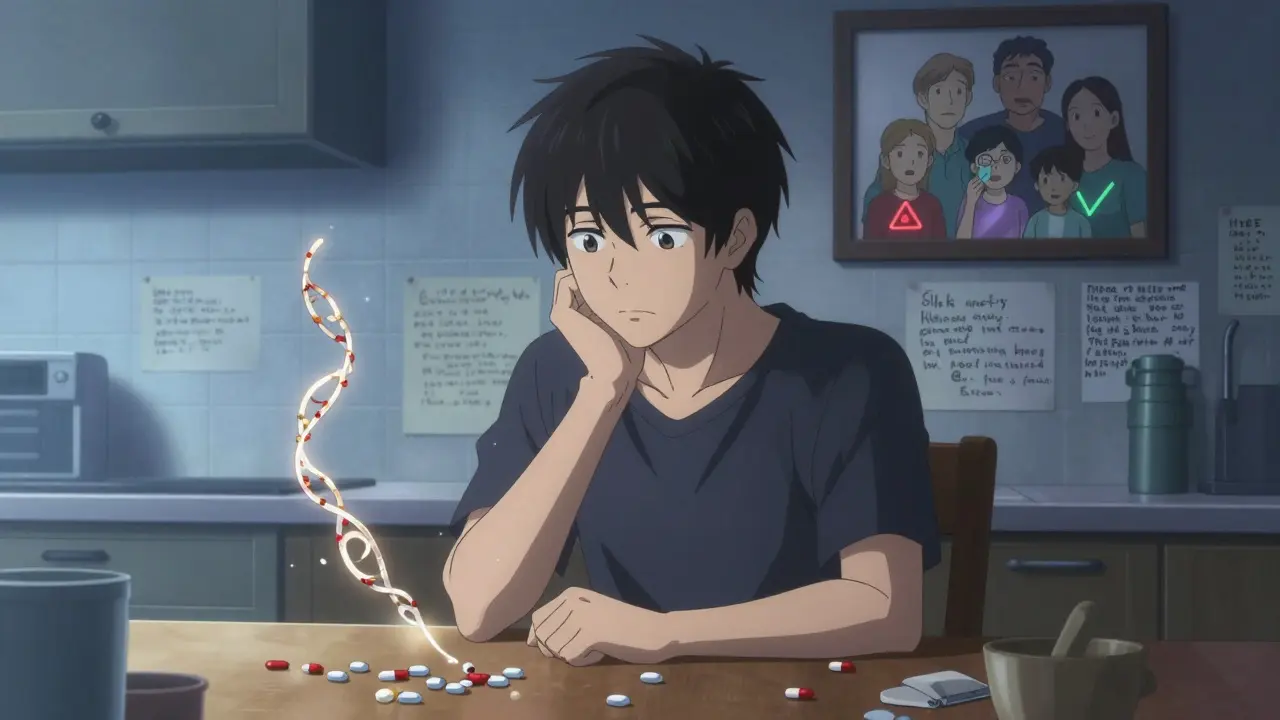
When you switch to a generic drug, you expect the same effect as the brand-name version. But what if your body reacts differently-not because the drug is weaker, but because of your genes? This isn’t science fiction. It’s happening right now, and your family history might hold the key.
Why Your Body Responds Differently to the Same Drug
Not everyone processes medication the same way. Two people taking the exact same generic pill at the same dose can have wildly different outcomes. One feels better. The other gets sick. Why? It’s not about the drug. It’s about your genes.The science behind this is called pharmacogenetics the study of how inherited genetic differences affect how your body responds to medications. Think of your genes as the instruction manual your body uses to break down and use drugs. Some people have manuals with typos. Those typos change how fast or slow your body processes medicine.
Take CYP2D6 a liver enzyme gene that metabolizes about 25% of all prescription drugs, including common antidepressants and painkillers. Over 80 different versions of this gene exist. Some make you a fast metabolizer-you break down the drug too quickly, so it doesn’t work. Others make you a slow metabolizer-you build up too much of the drug, leading to dangerous side effects. A person with two slow versions of CYP2D6 might get serotonin syndrome from a standard dose of sertraline. Their parent likely had the same gene variation.
Your Family’s Drug History Is a Clue
If your mom couldn’t tolerate the generic version of a blood pressure pill, or your dad had a bad reaction to a painkiller, that’s not coincidence. It’s inheritance. Pharmacogenetic traits often run in families. If multiple relatives had bad reactions to the same class of drugs, you’re more likely to have similar issues.For example, if your family has a history of severe side effects from warfarin a blood thinner whose dosing is strongly influenced by CYP2C9 and VKORC1 gene variants, your risk isn’t just higher-it’s predictable. Studies show that people with certain variants in these genes need 30% less warfarin than others. Without knowing this, switching to a generic version could mean a dangerous overdose.
Same goes for 5-fluorouracil a chemotherapy drug that can cause life-threatening toxicity in people with DPYD gene mutations. A patient in a 2023 Reddit thread shared that after their Color Health test revealed a DPYD variant, their oncologist cut their dose by one-third. They finished chemo without the severe diarrhea and low blood counts that killed others in their treatment group. That test didn’t come out of nowhere-it came from family history.
Population Differences Matter More Than You Think
Your ancestry isn’t just about where your family came from-it affects how your body handles drugs. A 2024 study in Nature Scientific Reports found that genetic variants affecting drug response vary dramatically between populations.For example, about 15-20% of Asians are poor metabolizers of proton pump inhibitors (like omeprazole) due to CYP2C19 variants. That means generic versions of these drugs often don’t work well for them. Meanwhile, 2-5% of Caucasians have the same issue. If your doctor prescribes the same dose based on average guidelines, you’re at risk.
African Americans typically need higher doses of warfarin than Europeans because of differences in VKORC1 and CYP2C9 genes. But many prescriptions still use one-size-fits-all dosing. Switching to a generic doesn’t change the drug’s chemistry-it just removes the brand name. Your body still responds based on your genes.
Genetic Testing Is Already Here-But Not Everyone Uses It
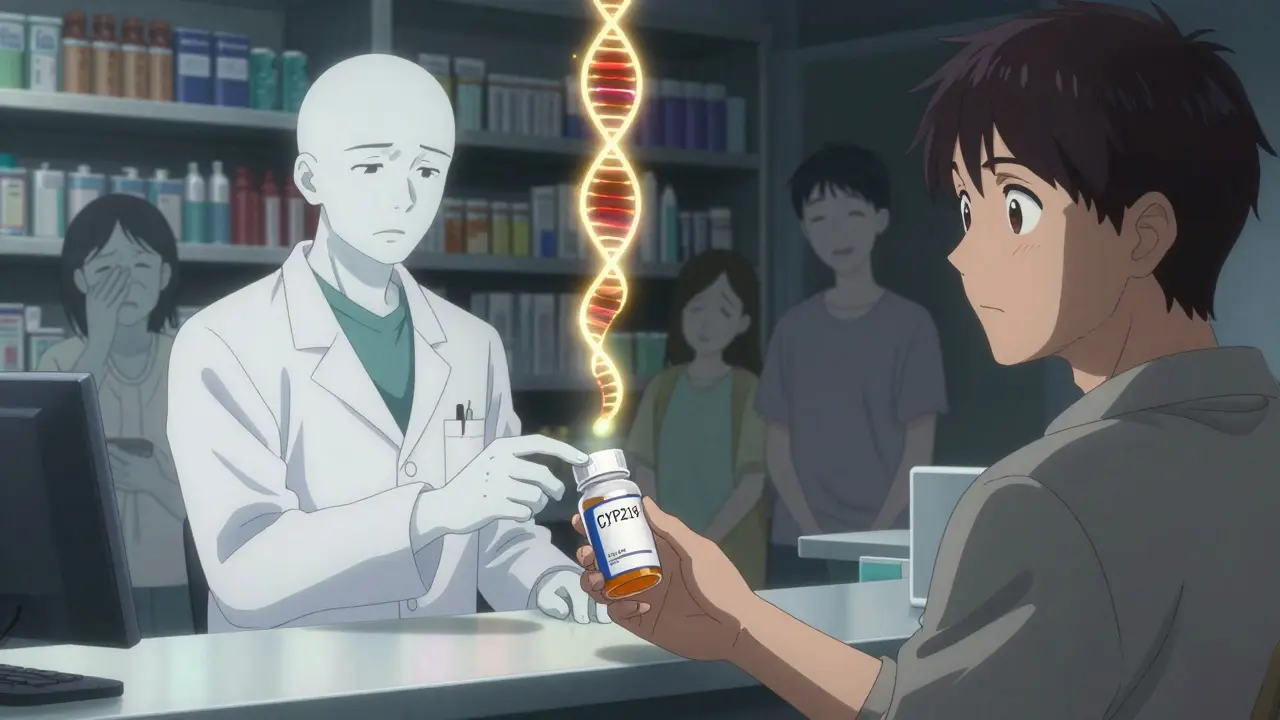
The FDA has updated over 300 drug labels to include pharmacogenetic information. That includes common generics like clopidogrel, statins, and antidepressants. But here’s the catch: most doctors don’t check your genes before prescribing.Why? Because it’s not routine. A 2022 survey of 1,247 clinicians showed that while 68% felt confident reading CYP2D6 results, only 32% felt confident about HLA-B*15:02 (which predicts severe skin reactions to carbamazepine). And 79% said they didn’t have time to use the data.
But some hospitals are changing that. Mayo Clinic’s preemptive testing program tested 10,000 patients and found 42% had at least one high-risk gene-drug interaction. Of those, 67% had their meds changed-and adverse events dropped by 34%. That’s not a small win. That’s life-saving.
Testing isn’t expensive anymore. Companies like Color Genomics and OneOme offer multi-gene panels for under $250. Some insurance plans cover it. And if you’ve had a bad reaction to a generic drug before, it’s worth asking your doctor: “Could this be genetic?”
What You Can Do Right Now
You don’t need a lab report to start protecting yourself. Here’s how to take control:- Ask your family: Who had bad reactions to medications? Which ones? Write it down. Even vague answers help.
- Check your prescriptions: Look at the drug label. If it mentions “CYP2D6,” “CYP2C19,” or “TPMT,” your genes matter.
- Ask your pharmacist: They’re trained to spot gene-drug conflicts. Say: “I’m switching to a generic. Could my genes affect how it works?”
- Request testing if you’ve had side effects: If a generic made you dizzy, nauseous, or caused a rash, get tested. It’s not paranoia-it’s prevention.
- Keep a drug reaction log: Note the drug, dose, reaction, and date. This helps your doctor spot patterns over time.

The Future Is Personalized, Not Generic
The push for generic drugs was meant to save money. But if a cheap pill makes you sick, you’re not saving anything-you’re paying in hospital visits, missed work, and pain.Pharmacogenetics is shifting the game. Instead of guessing what dose you need, we can now know. Instead of hoping a generic works, we can predict whether it will.
By 2025, 92% of academic medical centers plan to expand genetic testing programs. The NIH spent $127 million in 2023 just to study how genes affect drug response in underrepresented populations. That’s not a trend. That’s a revolution.
Switching to generics isn’t wrong. But ignoring your genes? That’s risky. Your family history isn’t just stories-it’s a warning system. And if you’ve ever had a drug that didn’t work-or made you worse-you already know how important this is.
Can family history alone tell me how I’ll react to a generic drug?
Family history gives you strong clues-if multiple relatives had bad reactions to the same drug, you’re at higher risk. But it’s not a substitute for genetic testing. Some gene variants aren’t obvious from family patterns, especially if relatives didn’t take the drug or had mild reactions. Testing confirms what history suggests.
Do all generic drugs have the same genetic risks as brand-name ones?
Yes. Generic drugs contain the same active ingredient as brand-name versions, so they interact with your genes the same way. The difference is in inactive ingredients like fillers or dyes, which rarely affect metabolism. If your body reacts poorly to a brand-name drug because of your genes, the generic will likely do the same.
Is pharmacogenetic testing covered by insurance?
Sometimes. Medicare covers certain tests under the Molecular Diagnostic Services Program, especially for high-risk drugs like warfarin or chemotherapy agents. Private insurers vary-some cover testing if you’ve had a prior adverse reaction. Always check with your provider before ordering.
What if my doctor ignores my genetic test results?
Ask for a referral to a clinical pharmacist or pharmacogenetics specialist. Many hospitals have these experts. You can also share the Clinical Pharmacogenetics Implementation Consortium (CPIC) guidelines-these are the gold standard and are cited by the FDA. If your doctor refuses, consider switching providers.
How long does it take to get genetic test results for drug response?
Most commercial tests take 7-14 days. Some hospitals with in-house labs can return results in 3-5 days. If you’re starting a new medication with high genetic risk (like chemo or blood thinners), ask if expedited testing is available.



Patrick Jarillon
February 9, 2026 AT 20:33Okay, but let’s be real-this whole pharmacogenetics thing is just Big Pharma’s way of making you pay for tests so they can sell you MORE expensive drugs under a different label. 🤡
They don’t care if your genes are weird-they care if your wallet is full. I got my 23andMe results last year, and guess what? I’m a ‘super metabolizer’ of everything. So now I’m supposed to pay $200 for a test that tells me what my body already proved by surviving 12 different antibiotics in college? Nah. I’ll take my chances with the generic. The real conspiracy? They won’t tell you that generics are sometimes made in the same factories as brand names. Same pills. Different sticker.
Also, CYP2D6? Please. I’ve been on 7 antidepressants. I know my body better than any algorithm. If you’re scared of generics, maybe you’re just scared of saving money.
And don’t get me started on ‘family history.’ My uncle died from a heart attack after taking lisinopril. So now I’m supposed to believe my 17-year-old cousin’s future meds are pre-determined by that? That’s not science. That’s astrology with a lab coat.
John Watts
February 10, 2026 AT 09:28This is actually one of the most important posts I’ve read all year. Seriously. I had no idea my grandma’s reaction to codeine was genetic-turns out, she was a slow metabolizer, and so am I. I switched to a generic oxycodone last year and ended up in the ER with respiratory depression. Turns out, the generic had the same active ingredient. Same chemistry. Same gene nightmare.
Now I get tested before every new prescription. My pharmacist calls me ‘the gene guy.’ I don’t mind. I’m alive because I asked the right questions.
And yeah, testing isn’t perfect-but it’s better than guessing. If you’ve ever been sick from a pill that ‘should’ve worked,’ you owe it to yourself to dig into your family’s drug history. It’s not paranoia. It’s power.
Randy Harkins
February 11, 2026 AT 00:18Thank you for sharing this 💙
I just got my Color Genomics results back last month, and wow-turns out I’m a CYP2C19 poor metabolizer. I’ve been on generic Prozac for 5 years and thought I was just ‘sensitive.’ Turns out, my body was basically sitting on a pile of unprocessed serotonin.
My doctor changed my dose, and I feel like a new person. No more brain fog. No more nausea. Just… clarity.
It’s wild how much our bodies are whispering to us if we just learn how to listen. Family history + testing = superpower. If you’ve ever felt ‘off’ on a med, don’t brush it off. Ask. Test. Advocate. You’ve got this.
Tori Thenazi
February 11, 2026 AT 11:22Okay, but… have you heard about the 2021 CDC memo that was buried? The one that said the FDA knew about 87% of generic drug manufacturers using different fillers that interact with CYP enzymes… but didn’t require disclosure because ‘it’s not clinically significant’? 😳
And now they want us to trust ‘same active ingredient’? What about the titanium dioxide in the coating? The corn starch? The dye? I read a paper that said some dyes trigger immune responses in people with MTHFR mutations-AND THEY’RE NOT LISTED ON THE LABEL.
My cousin had a full-body rash from a generic metformin. They said it was ‘allergic reaction.’ But her DNA showed no allergy. Just a bad filler. The system is rigged. They don’t want you to know this. I’m not paranoid-I’m informed. And if you’re not testing your genes? You’re playing Russian roulette with your liver.
Elan Ricarte
February 11, 2026 AT 17:14LMAO at people who think ‘family history’ is enough. My dad died from a bleeding ulcer after a generic warfarin switch. The doc said ‘it’s just a blood thinner, same thing.’
Turns out? Dad had two copies of VKORC1*2. He needed 1.5mg. They gave him 5mg. He bled out in 72 hours.
And now? The FDA says ‘test if you want.’ Like, cool. Thanks for the ‘option.’
Meanwhile, I’m over here with a printed CPIC guideline shoved in my wallet, and I’ve got my pharmacist on speed dial. If your doctor looks at you like you’re crazy for asking about CYP2D6? Walk out. Find someone who speaks human.
And don’t even get me started on how 70% of pharmacists still don’t know what HLA-B*15:02 is. This isn’t medicine. It’s a fucking lottery.
Angie Datuin
February 11, 2026 AT 22:58I just wanted to say thank you for this. I’ve been on generic sertraline for 4 years and thought I was just ‘not responding.’ Turns out, I’m a CYP2D6 ultra-rapid metabolizer. My body was flushing it out before it could work. I got tested after reading this, switched to a different SSRI, and now I’m sleeping through the night for the first time in a decade.
It’s not about being ‘extra.’ It’s about being heard.
Your body is trying to tell you something. Listen.
Camille Hall
February 12, 2026 AT 22:14This is such an important conversation. I work as a nurse in a rural clinic, and I’ve seen so many patients suffer because they were told, ‘It’s just a generic, it’s the same.’
One woman, 68, had three hospitalizations from generic clopidogrel. She had a TPMT variant. Her son had the same reaction. They didn’t know. No one asked. We finally got her tested-and now she’s stable.
It’s not about fear. It’s about awareness. Talk to your family. Write it down. Bring it to your doctor. You don’t need a PhD to save your life. Just curiosity and courage.
Ritteka Goyal
February 14, 2026 AT 06:27OMG I AM SO HAPPY YOU WROTE THIS BECAUSE IN INDIA WE HAVE SO MANY GENERIC DRUGS AND NO ONE TELLS YOU ABOUT GENES!! MY SISTER TOOK A GENERIC STATIN AND GOT SEVERE MUSCLE PAIN AND THEY SAID SHE WAS JUST WEAK!! BUT HER MOTHER HAD THE SAME THING AND WE JUST THOUGHT IT WAS COINCIDENCE!!
WE FOUND OUT SHE HAS CYP3A4 VARIANT AND NOW SHE IS ON A DIFFERENT DRUG AND FEELS AMAZING!!
SO MANY PEOPLE IN INDIA ARE DUMB ABOUT THIS!! DOCTORS JUST GIVE YOU THE CHEAPEST ONE AND SAY ‘IT’S SAME’ BUT NOOOO IT’S NOT SAME FOR YOUR BODY!!
MY COUSIN IN DELHI HAD TO BE HOSPITALIZED BECAUSE OF GENERIC CHLOROQUINE-BUT HER FAMILY HISTORY SAID HER GRANDMA DIED FROM IT TOO!! WHY NO ONE TOLD US??
PLEASE MORE PEOPLE NEED TO KNOW THIS!! WE CANNOT TRUST THE SYSTEM!!
Monica Warnick
February 15, 2026 AT 03:17I got tested after reading this. My results came back: CYP2D6 poor metabolizer. I’ve been on 3 different generics for anxiety. All made me nauseous. All made me feel ‘numb.’ I thought I was broken.
Turns out, I just needed to know.
I switched to the brand name. Not because it’s better. But because I finally understood why.
It’s not about money. It’s about dignity. You deserve to feel okay. And sometimes, your genes are the only ones who know how.
Ashlyn Ellison
February 15, 2026 AT 18:35