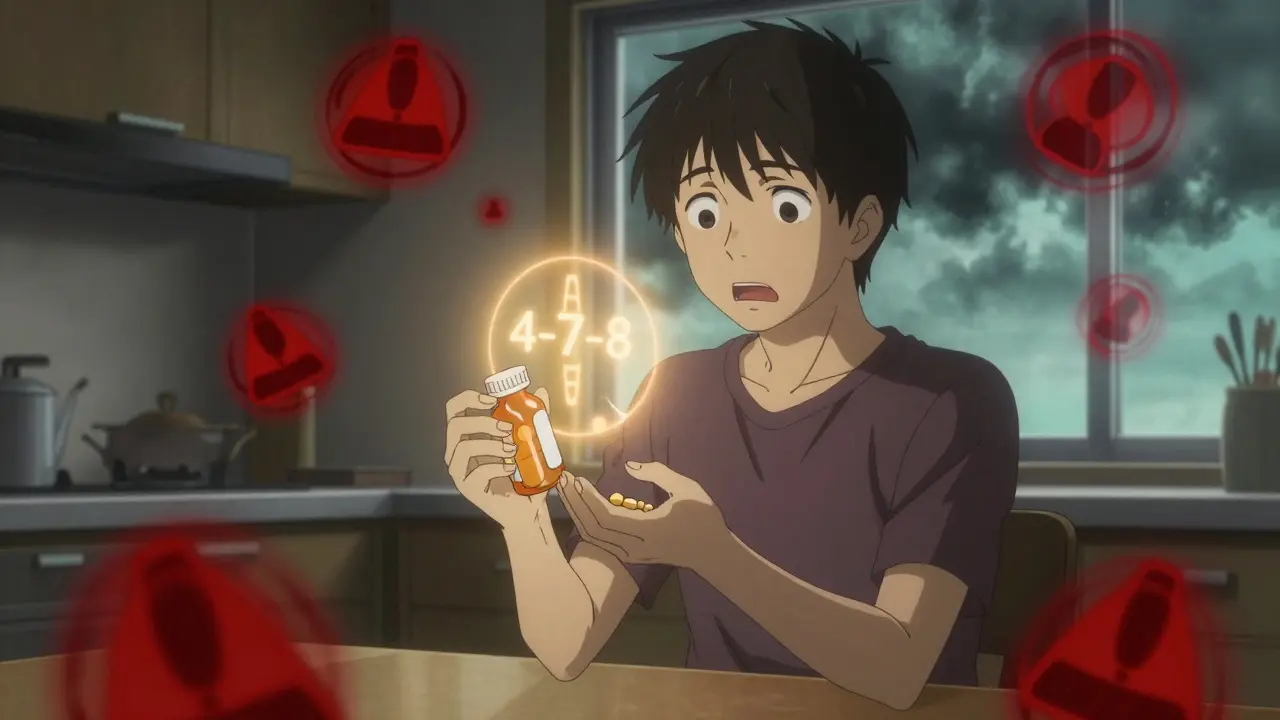
When you get a drug safety alert-whether it’s from your pharmacy, your doctor, or a government warning-your heart might jump. Your hands might shake. Your mind races: Is this dangerous? Should I stop taking it? What if I’ve already been hurt? That panic is normal. But it’s also dangerous. In the heat of the moment, panic makes you miss facts, ignore instructions, and make choices you’ll regret later. The good news? You don’t have to react like that. You can learn to pause, think, and act with clarity-even when your body is screaming to run.
Why Panic Makes Drug Safety Alerts Worse
Your brain isn’t designed to handle alerts calmly. When you see the word “warning” or “recall,” your amygdala-your brain’s alarm system-fires off a stress signal. Your heart rate spikes to 110-130 beats per minute. Your breathing gets shallow and fast. Your prefrontal cortex, the part that thinks logically, shuts down. That’s why people do things like toss out their entire prescription bottle without checking the details, or skip doses for days out of fear. A 2022 study from the American Psychological Association found that panic reduces decision accuracy by up to 67% during medical alerts. You’re not being irrational-you’re biologically hijacked.Step 1: Stop. Breathe. Ground Yourself
The first thing you need to do is break the panic cycle. Don’t try to think your way out of it. Start with your body. Use the 4-7-8 breathing technique: inhale through your nose for 4 seconds, hold for 7, then exhale slowly through your mouth for 8. Do this three times. Within 90 seconds, your heart rate will drop from panic levels to a calm 70-85 bpm. That’s the window where your brain can start thinking again. If breathing feels too hard right now, try the 5-4-3-2-1 grounding method. Look around and name:- 5 things you can see (your coffee mug, the wall clock, your phone, the window, your shoes)
- 4 things you can touch (the fabric of your shirt, the arm of your chair, your keys, your water bottle)
- 3 things you can hear (the hum of the fridge, birds outside, your own breath)
- 2 things you can smell (mint toothpaste, fresh laundry)
- 1 thing you can taste (sip some water, chew a mint)
Step 2: Don’t Act Until You Have the Facts
Drug safety alerts are often vague. They might say “potential risk” or “reported side effects.” That’s not the same as “stop immediately.” Many alerts are based on rare cases, not common outcomes. For example, a 2023 FDA alert on a blood pressure medication mentioned a possible link to muscle pain in fewer than 1 in 5,000 users. That doesn’t mean you should quit. It means you should check. Here’s what to do next:- Find the official source. Is it from the FDA, TGA (Therapeutic Goods Administration), or your country’s drug regulator? Avoid blogs or social media posts.
- Look for the exact drug name and batch number. Alerts often target specific lots, not entire brands.
- Check the risk level. Is it a Class I (immediate danger), Class II (temporary or reversible), or Class III (unlikely to cause harm)?
- Call your pharmacist or doctor. Don’t wait. Say: “I got an alert about [drug name]. Can you help me understand if this applies to me?”
Step 3: Use a Decision Filter
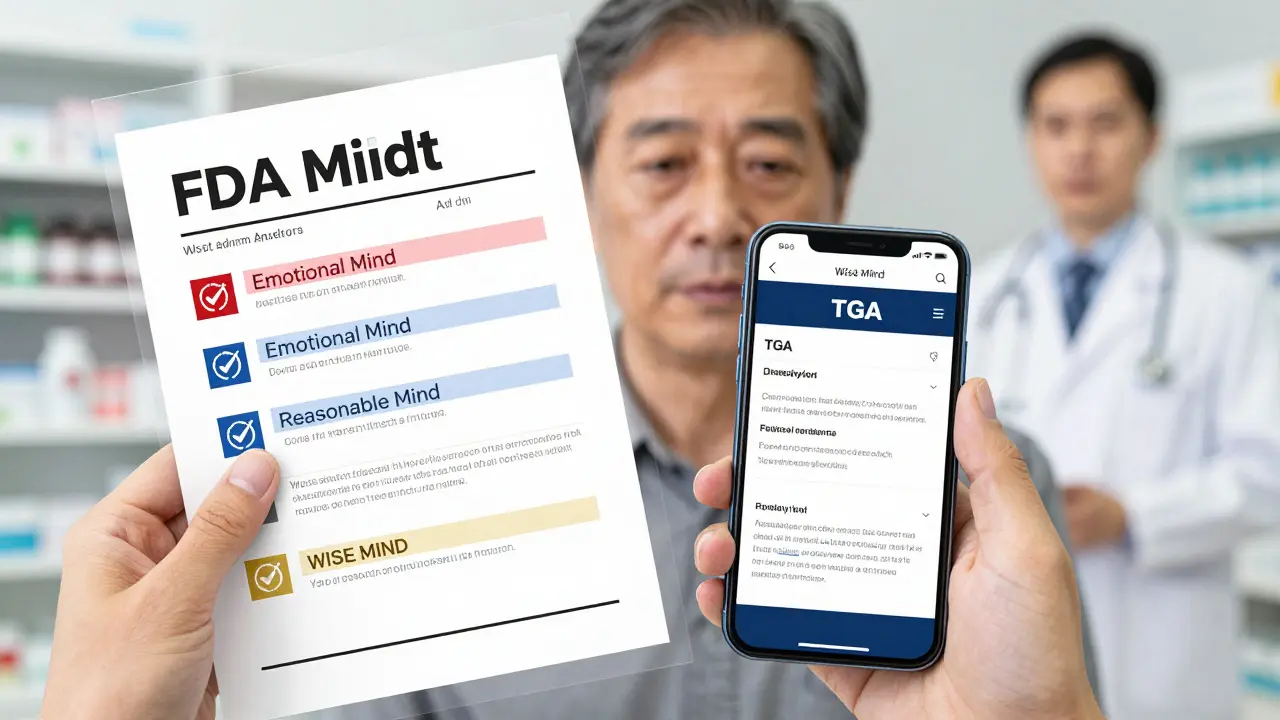
When your mind is racing, you need a simple structure. Try the “WISE MIND” check:- Emotional Mind: What am I feeling? (Fear? Anger? Shame?)
- Reasonable Mind: What does the data say? (Is the risk real? How common? What’s the official advice?)
- WISE MIND: What’s the balanced choice? (Not what I’m scared to do. Not what I think I should do. What’s actually safe and smart?)
Step 4: Prepare Before the Next Alert
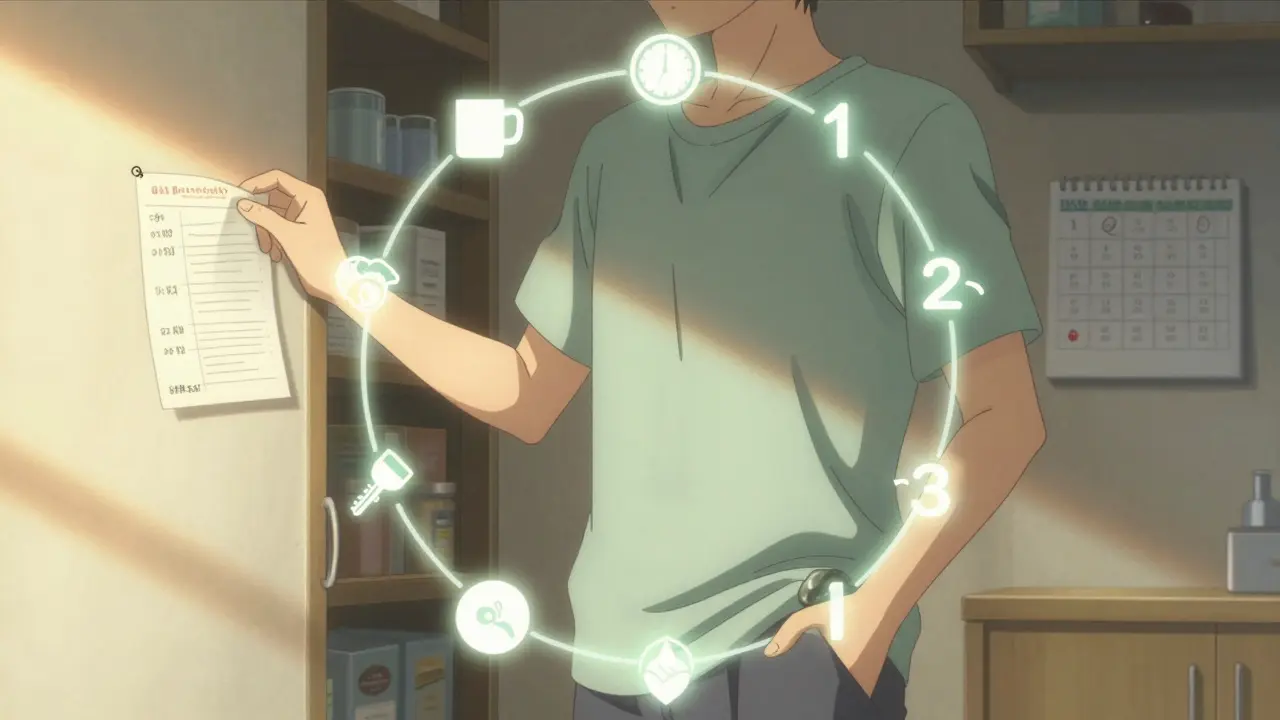
You wouldn’t wait until a fire breaks out to learn how to use a fire extinguisher. Same with drug alerts. The people who handle them best are the ones who practiced ahead of time. Build a simple “alert response kit”:- Keep a printed copy of your current meds, dosages, and prescribing doctor’s contact info.
- Store a small object in your wallet or purse-a smooth stone, a mint, a textured keychain-that you can touch during panic to ground yourself.
- Write down your personal decision rule: “I will always call my pharmacist before stopping any medication.” Tape it to your medicine cabinet.
- Practice breathing or grounding for 5 minutes every morning. Just 10 minutes a day for 30 days increases your brain’s ability to stay calm under stress by 4.3%, according to research from Mindful.org.
What to Do If You’re Still Overwhelmed
Sometimes, even after breathing and checking facts, you still feel stuck. That’s okay. You don’t have to solve it alone. Reach out to:- Your pharmacist-they’re trained to interpret alerts and can explain risks in plain language.
- Your doctor’s office. Many now have nurses on call specifically for medication questions.
- A mental health counselor who specializes in health anxiety. If you find yourself checking alerts every hour or avoiding meds out of fear, you’re not alone. Around 78.6% of people in this situation improve with CBT and mindfulness.
Real Stories: What Worked
One user in Sydney, “Marianne K.,” got an alert about her diabetes medication. She panicked, skipped two days, and ended up in the ER with high blood sugar. After working with a counselor, she created her own alert checklist. The next time she got a warning about her blood pressure drug, she used her 5-4-3-2-1 technique, called her pharmacist, and found out the alert was for a different brand. She kept taking her meds safely. Another, a nurse named David in Melbourne, used to freeze every time a hospital alert popped up. He started doing 30 seconds of jumping jacks (part of the TIPP method) before responding. He says it cut his reaction time from 6 minutes to under 90 seconds. “Now I feel like I’m in charge,” he told his team.Why This Matters More Than Ever
In 2026, the average person gets 67 alerts a week-from phones, banks, apps, and now, health systems. Drug safety alerts are just one part of that flood. The European Union’s DORA law, which took effect in January 2025, now requires healthcare providers to train staff on psychological responses to alerts. That’s because panic doesn’t just hurt individuals-it can cause system-wide errors. A nurse who panics and mislabels a drug batch, or a patient who stops a life-saving med, can trigger a chain reaction. The future of drug safety isn’t just better software. It’s better human responses. And that starts with you learning how to breathe, check facts, and choose wisely-even when your body tells you to run.Should I stop taking my medication right away if I get a safety alert?
No. Most drug safety alerts do not mean you should stop immediately. Many are based on rare cases, outdated data, or specific batches. Stopping suddenly can be dangerous-especially for medications like blood thinners, antidepressants, or seizure drugs. Always contact your pharmacist or doctor first. They can tell you if the alert applies to your specific prescription and what to do next.
What’s the difference between a Class I and Class III drug alert?
Class I alerts mean there’s a reasonable chance the drug could cause serious harm or death. These are rare and require immediate action, like stopping the medication or returning it. Class II alerts mean the drug might cause temporary or reversible harm. Class III alerts mean the risk is minimal and unlikely to cause any problem. Most alerts you receive are Class II or III. Check the official alert source for the classification-it’s usually listed clearly.
Can I rely on social media or news headlines about drug alerts?
No. Social media and news headlines often exaggerate or misrepresent drug alerts to get clicks. A headline might say “Deadly Drug Recall!” when the actual alert only affects one batch of pills and has no reported deaths. Always go to the official source: your country’s drug regulatory agency (like the FDA in the U.S. or the TGA in Australia), your pharmacy, or your doctor. These are the only places that give accurate, complete details.
How often should I practice panic management techniques?
Practice daily, even when there’s no alert. Just 10 minutes a day of breathing exercises, grounding, or mindfulness builds your brain’s ability to stay calm under pressure. Studies show that after 30 days of consistent practice, your response time to real alerts improves by 83%. You’re not training for a crisis-you’re training your brain to handle stress better, so when an alert comes, you’re already ready.
Are there tools or apps that help manage panic during drug alerts?
Yes. Some wearable devices now detect when your heart rate spikes during an alert and automatically trigger guided breathing exercises. There are also apps that walk you through the 5-4-3-2-1 technique or send you a pre-written checklist to follow. But the most effective tool is still your own preparation: a printed list of steps, a grounding object, and a trusted contact number. Tech helps-but your calm mind is the real safety net.




Colin Pierce
January 29, 2026 AT 12:00Man, this is exactly what I needed. I panicked last month when my blood pressure med got flagged on a Reddit thread-turned out it was a batch issue from 2021. I almost quit cold turkey. Thanks for laying out the steps so clearly. Breathing first? Genius. My brain finally stopped screaming.
matthew martin
January 29, 2026 AT 12:17Love this. Not just because it’s practical, but because it treats people like humans, not data points. The 5-4-3-2-1 trick? I’ve been using it since my anxiety diagnosis-now I use it when my phone pings with a ‘URGENT’ email too. Grounding isn’t woo-woo, it’s neurology in sneakers.
doug b
January 30, 2026 AT 08:22Stop. Breathe. Call your pharmacist. That’s the whole playbook. No fluff. No fear. Just three things you can do right now. I’ve told my mom this a dozen times. She’s 72, on six meds, and still reads every alert like it’s a death sentence. This post? She printed it out.
Mel MJPS
January 30, 2026 AT 21:32I used to scroll through drug alerts like they were gossip. Now I keep a sticky note on my pillbox that says ‘CALL FIRST.’ It saved me last week when my antidepressant got flagged-turns out, it was a typo in the batch number. Phew. Thank you for writing this like someone who’s been there.
Brittany Fiddes
February 1, 2026 AT 00:35Oh please. Another American wellness guru peddling breathing exercises like they’re magic potions. In the UK, we have the NHS-trained professionals who actually know what they’re talking about, not some blog that cites ‘studies’ from ‘Mindful.org.’ If you can’t trust your doctor, you shouldn’t be taking pills at all. This whole post is a distraction from systemic healthcare failures.
Irebami Soyinka
February 1, 2026 AT 06:33LOL 😂 this is why Africa doesn’t trust Western medicine. You people panic over a *batch number*? Back home, we take what’s given and thank God. No 5-4-3-2-1, no ‘WISE MIND’-just faith and a prayer. But hey, if you need to touch your keys and name your shoes to feel safe, go ahead. Meanwhile, my cousin in Lagos takes his malaria pills with palm wine and still runs marathons. 🙏
Phil Davis
February 1, 2026 AT 10:04So… we’re supposed to breathe through a pharmaceutical apocalypse? Cool. I’m just glad we’ve moved from ‘just take your meds’ to ‘take your meds, but also do yoga while you’re at it.’ Next thing you know, we’ll be asked to meditate before our insulin shot. 🙃
Jeffrey Carroll
February 2, 2026 AT 17:13While the tone of this post is reassuring, I’d caution against over-reliance on techniques that assume a level of cognitive stability that isn’t always present during acute stress. For some, even the 4-7-8 method is too complex. Simplicity-like keeping a printed checklist and a trusted contact on speed dial-is the true safety net. I’ve seen patients who couldn’t remember their own name during panic. This article helps-but it’s not universal. Adapt it. Simplify it. Make it real.