When you have COPD, breathing gets harder. But what most people don’t realize is that your muscles are also breaking down - faster than they should. This isn’t just about getting older. It’s called sarcopenia, and it’s a silent threat in COPD that cuts survival rates and steals your independence. About 1 in 5 people with COPD lose so much muscle that they can’t climb stairs, carry groceries, or even get out of a chair without help. The good news? You can fight it. With the right nutrition and a smart approach to resistance training, many patients regain strength, cut hospital visits, and live longer.
Why Sarcopenia Hits Harder in COPD
Sarcopenia isn’t the same in COPD as it is in healthy aging. In older adults without lung disease, muscle loss mostly affects the legs. In COPD, it hits the chest, arms, and breathing muscles first. That’s because your body is stuck in survival mode. Low oxygen levels, especially at night, trigger inflammation. Chemicals like TNF-α and IL-6 flood your system, telling your muscles to break down. At the same time, you’re less active - not because you’re lazy, but because every step feels like climbing a mountain. Add in poor appetite, common in advanced COPD, and you’re not eating enough protein to rebuild what’s being lost.
Studies show COPD patients lose muscle at 3.2% per year - nearly double the rate of healthy seniors. And it’s not just about looks. Patients with sarcopenia have 20-40% higher death rates. One study found that if you have both severe COPD and sarcopenia, your five-year survival chance drops from 45% to just 27%. But here’s the turning point: when you treat the muscle loss, survival jumps to 68%.
How Doctors Diagnose It - And Why Most Miss It
Most clinics don’t screen for sarcopenia. They check your lungs, not your muscles. But the tools are simple. The European Working Group on Sarcopenia (EWGSOP2) says the first sign is weak grip strength - under 27 kg for men, under 16 kg for women. That’s easier to test than you think. A handgrip dynamometer costs less than $100. The next step is checking how fast you walk 4 meters. If it’s slower than 0.8 meters per second, that’s a red flag. For more detail, doctors can use CT scans to measure muscle at the L3 spine. In COPD patients, a muscle index below 55 cm²/m² for men or 39 cm²/m² for women signals sarcopenia.
But here’s the twist: BMI doesn’t work well for COPD. Many patients are thin, but their muscle mass is even thinner. That’s why researchers now use the pectoralis muscle index (PMI) - measuring the size of the chest muscle relative to body weight. A PMI below 1.06 cm²/BMI is a strong predictor of sarcopenia in COPD. Yet, only 38% of U.S. pulmonary rehab centers screen for it. Most still rely on outdated methods. If your doctor hasn’t checked your grip strength or walking speed, ask for it.
Nutrition: More Than Just Calories
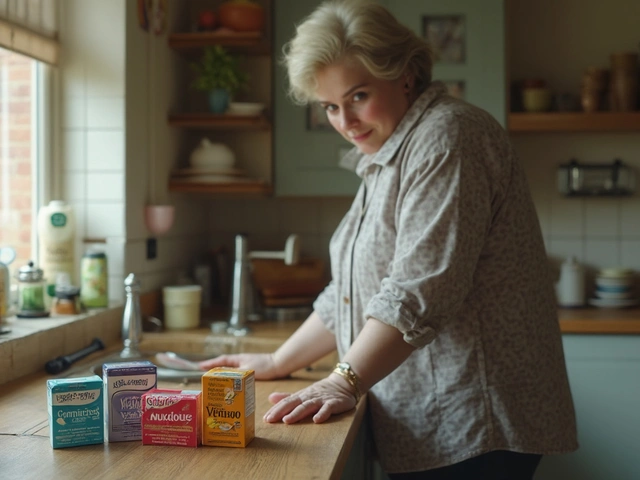
You’ve probably heard, “Eat more protein.” But it’s not that simple. Most COPD patients eat only 0.8-1.0 grams of protein per kilogram of body weight. The recommended amount? 1.2 to 1.5 grams per kg. For a 70 kg (154 lb) person, that’s 84-105 grams of protein daily - about 3-4 chicken breasts. But you can’t just eat it all at dinner. Your body can only use about 30-40 grams of protein at once to build muscle. So spread it out: 3-4 meals with 25-30 grams each.
Leucine is the key amino acid that kicks off muscle repair. It’s found in whey, eggs, chicken, and soy. Studies show adding 2.5-3.0 grams of leucine per meal boosts muscle synthesis by 37% in sarcopenic COPD patients. That’s why many rehab programs now use whey protein shakes with added leucine - one shake at breakfast, one at lunch, one at dinner. For patients with poor appetite, liquid supplements with 10g leucine and 25g protein can be easier to tolerate than solid food.
Don’t forget vitamin D. Low levels are common in COPD and linked to weaker muscles. Aim for 800-1000 IU daily. Omega-3s from fish oil may also help reduce inflammation. But protein is the foundation. Without enough, no exercise will help.

Resistance Training: Start Low, Go Slow
You might think, “I can’t lift weights - I can’t even walk.” But resistance training doesn’t mean heavy barbells. It means controlled, low-load movements that build strength without wrecking your breath.
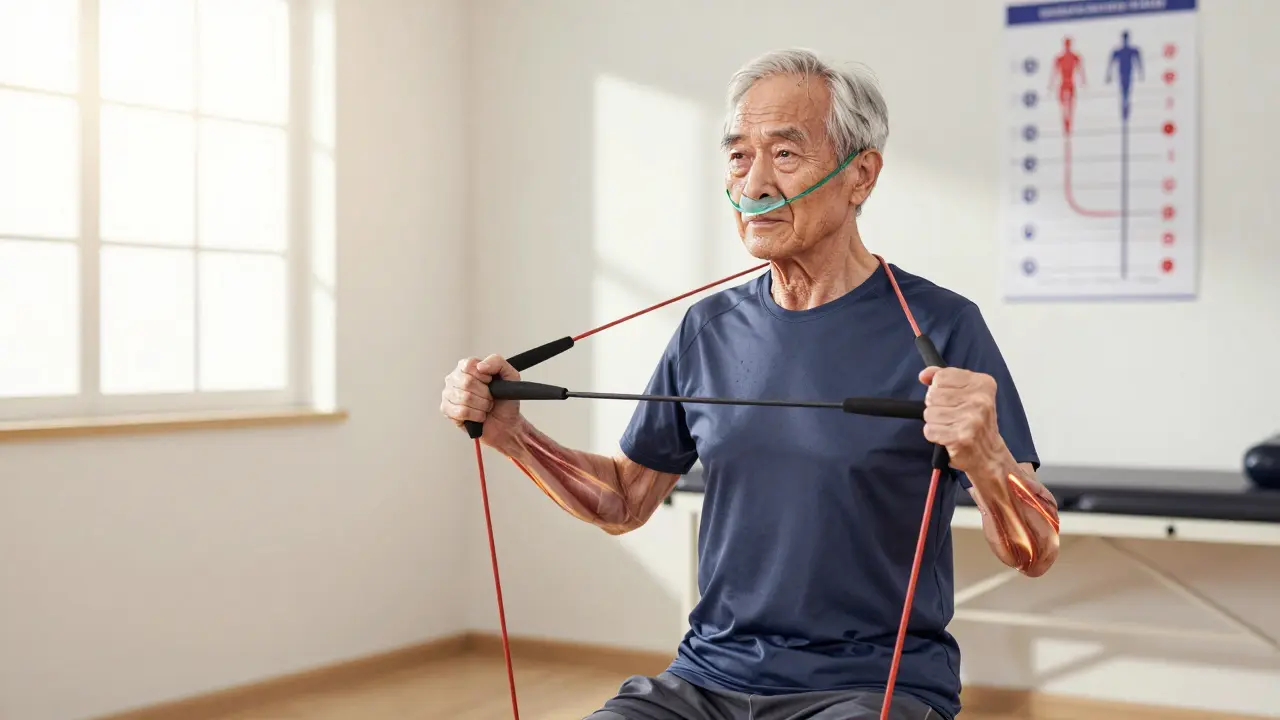
Start with 30% of your one-rep max. That’s often just 1-2 pound dumbbells or resistance bands. Do 2-3 sets of 10-15 reps, twice a week. Focus on major muscles: shoulders, chest, arms, legs. A simple routine could be: seated shoulder presses, band rows, leg extensions, and heel raises. Rest 2-3 minutes between sets. That’s not laziness - it’s necessary. COPD patients need longer recovery because their oxygen demand spikes with effort.
Many need supplemental oxygen during training. One study found 42% required it - far more than non-COPD patients. If you’re on oxygen, keep using it during exercise. Don’t remove the nasal cannula. It’s not cheating; it’s survival.
Progress slowly. In 8-12 weeks, most patients can increase to 60-80% of their max. That’s when real gains kick in. One rehab program in Cleveland saw a 23% improvement in 6-minute walk distance after 16 weeks of this approach. That’s the difference between needing help to get dressed and doing it alone.
Real Stories: What Works - and What Doesn’t
Mary Thompson, 68, with GOLD Stage 3 COPD, started with resistance bands and 30g of protein at each meal. “I couldn’t carry my purse without stopping,” she says. “After 12 weeks, I carried groceries - no breaks. I cried when I realized I could do it.”
John Peterson, 72, tried the same program but stopped after three sessions. “Every lift made me gasp. I felt like I was drowning.” He didn’t know he needed oxygen during training. His rehab team hadn’t explained it. He quit.
These stories aren’t rare. A review of 147 patient reports showed 68% improved - but 32% quit because their breathing got worse. The difference? Education. Patients who understood why they needed oxygen, rest, and protein stayed with it. Those who didn’t, gave up.

What’s New in 2026 - And What’s Coming
The GOLD guidelines just released their first sarcopenia algorithm for COPD. It now links nighttime oxygen levels to exercise prescriptions. If your oxygen drops below 88% for more than 30% of sleep, your rehab plan changes - more oxygen during training, earlier protein timing, and slower progression.
A major trial called EU-SARC-COPD is launching in September 2024. It’s testing HMB, a supplement that helps preserve muscle during illness. Early results show 18% more muscle retention than placebo. And a new drug, PTI-501, a myostatin inhibitor, is in phase 2 trials. It blocks a protein that stops muscle growth. Results are expected in early 2025.
But the biggest change isn’t a drug. It’s awareness. By 2027, experts predict sarcopenia screening will be standard in all COPD clinics. Why? Because it’s cost-effective. Treating sarcopenia cuts hospitalizations by 32% and adds 0.42 quality-adjusted life years per patient - more than most COPD medications.
What to Do Now
If you have COPD:
- Ask your doctor to test your grip strength and 4-meter walk speed.
- Track your protein intake. Aim for 1.2-1.5g per kg daily. Spread it over 3-4 meals.
- Start resistance training with bands or light weights. Two days a week. Rest between sets.
- If you use oxygen, wear it during exercise - no exceptions.
- Don’t quit if you’re short of breath. Adjust. Slow down. Rest. Keep going.
Sarcopenia in COPD isn’t inevitable. It’s treatable. And the tools are simple: protein, movement, and oxygen. You don’t need to be an athlete. You just need to start - and stick with it.