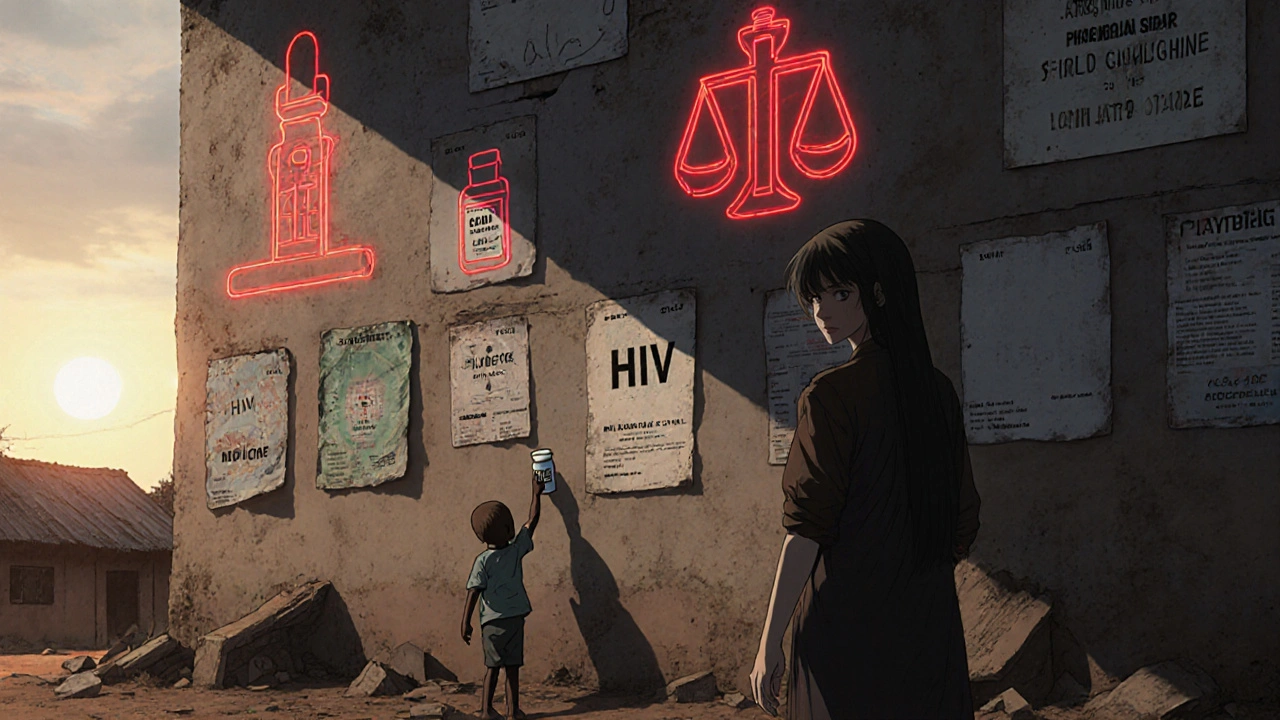
When a person in Malawi needs HIV medicine, or a child in Bangladesh needs asthma inhalers, the price tag isn’t just about cost-it’s about patent law. The TRIPS Agreement, signed in 1994 and enforced in 1995, was meant to create fair global trade rules. But for medicines, it created a wall. Before TRIPS, countries like India made life-saving generic drugs at 5% to 10% of the price of branded versions. Today, that same drug might be locked behind a 20-year patent, even if thousands die waiting for it to expire.
What TRIPS Actually Does to Medicine Access
The Agreement on Trade-Related Aspects of Intellectual Property Rights (TRIPS) forces every World Trade Organization (WTO) member to give drug companies 20 years of patent protection. That means no one else can copy the formula-not even if the medicine costs $10,000 a year and the country can’t afford it. Before TRIPS, many developing nations didn’t grant product patents for drugs. They made their own generics. India, for example, became the pharmacy of the Global South, supplying affordable antiretrovirals to over 100 countries. After TRIPS, that changed. Suddenly, any country that wanted to make a cheaper version of a patented drug risked trade sanctions, lawsuits, or political pressure. The system was built for profit, not patients.The Flexibilities That Don’t Work
TRIPS wasn’t completely rigid. It included so-called “flexibilities”-legal loopholes meant to help countries in emergencies. The biggest one is compulsory licensing: a government can force a patent holder to let someone else make the drug, as long as they pay a fee. This is legal under Article 31 of TRIPS. But here’s the catch: the license can only be used mostly for the domestic market. So if you’re a small country like Rwanda with no drug factories, you can’t make the medicine yourself, and you can’t import it from another country that made it under a compulsory license. That’s where the 2005 amendment-Article 31bis-was supposed to help. It created a way for countries without manufacturing capacity to import generics made under license. Only one country has ever used it: Rwanda, in 2008. They ordered HIV medicine from Canada’s Apotex. It took four years. Médecins Sans Frontières had to step in just to help fill out the paperwork. The process involved 78 separate steps across two governments. The final price? Still 30% higher than if Rwanda had been allowed to produce it locally.Why Nobody Uses the Rules
You’d think countries would use these flexibilities when people are dying. But 83% of low- and middle-income countries have never issued a single compulsory license-not because they don’t need to, but because they’re scared. The U.S. Trade Representative has placed countries like Thailand and Brazil on its “Priority Watch List” for daring to use TRIPS flexibilities. In 2006, Thailand issued licenses for three key drugs: efavirenz (HIV), clopidogrel (heart disease), and imatinib (cancer). Prices dropped by 30% to 80%. The U.S. responded by stripping Thailand of its trade benefits, costing the country an estimated $57 million a year in lost exports. South Africa tried in 1997 to pass a law allowing generic imports and compulsory licensing. Thirty-nine drug companies sued them. The lawsuit was dropped only after global protests. That’s the message: challenge the patent system, and you’ll get punished.
Voluntary Licenses Are Not Enough
Pharmaceutical companies sometimes offer “voluntary licenses” to generic manufacturers through groups like the Medicines Patent Pool (MPP). These allow some generic production, but only for a handful of drugs-mostly HIV treatments. As of 2022, MPP covered just 44 patented medicines across all diseases. That’s 1.2% of all patented drugs globally. And even those licenses are often restricted to sub-Saharan Africa, even though the same diseases exist in Asia, Latin America, and Eastern Europe. The system is designed to look generous, but it’s selective. It doesn’t touch cancer drugs, rare disease treatments, or most new medicines.TRIPS-Plus: The Hidden Rules
The real problem isn’t just TRIPS. It’s what comes after it: TRIPS-plus. When countries sign bilateral trade deals-like the U.S.-Jordan Free Trade Agreement or the EU-India negotiations-they’re forced to accept extra patent rules. These include extending patent terms beyond 20 years, blocking generic approval even after the patent expires, and requiring data exclusivity (meaning generic makers can’t use the original company’s clinical trial data to prove safety). These rules are buried in fine print, often negotiated under pressure. A 2021 WTO report found that 86% of WTO members have added TRIPS-plus restrictions through these deals. In some cases, patent protection is stretched to 25 years or more. That means a drug that should be affordable by 2025 might stay locked up until 2030.What’s Changing Now?
The pandemic changed the conversation. In 2020, India and South Africa proposed a full waiver of TRIPS protections for COVID-19 vaccines, tests, and treatments. After two years of pressure, the WTO agreed in June 2022 to a limited waiver-for vaccines only. Therapies and diagnostics were left out. The waiver is also temporary and full of conditions. Still, it was a crack in the wall. In September 2024, the UN held a major meeting on pandemic preparedness and called for “reform of the TRIPS Agreement to ensure timely access to health technologies.” That’s the first time a global body has openly said the system needs fixing. Meanwhile, the WHO and UNDP warn that without change, 3.2 billion people will lack access to essential medicines by 2030. Right now, 2 billion already do.
Why This Matters to Everyone
This isn’t just about poor countries. The same patent system affects you too. If a new cancer drug costs $150,000 a year, and no generic can be made for another 15 years, the cost gets passed down through insurance premiums, taxes, and out-of-pocket spending. The U.S. spends more on pharmaceuticals than any other country-not because it needs more drugs, but because it pays more for them. And when drug companies delay generic competition, they don’t just protect profits-they delay innovation. Why invest in new treatments if you can just extend patents on old ones? That’s what’s happening. Over 70% of new “drugs” approved in recent years are minor tweaks of existing ones-called “evergreening.”What’s the Path Forward?
There are three real solutions:- Fix Article 31bis. Make it simple, fast, and automatic. No more 78-step forms. No more political threats. Just a clear, public process.
- End TRIPS-plus. Stop allowing rich countries to sneak extra patent rules into trade deals. These are not trade agreements-they’re medicine control agreements.
- Build local manufacturing. Countries like India, South Africa, and Brazil have the capacity. They need support, not pressure. The WHO’s new strategy on digital health even says TRIPS flexibilities should apply to diagnostic tools and vaccines-not just pills.
What You Can Do
You don’t need to be a policymaker to care. Ask your pharmacy: “Is this drug patented? Is there a generic?” Support organizations like Médecins Sans Frontières, Health Action International, or the Treatment Action Campaign. Contact your representatives and ask: “Will you support a global system where medicine access isn’t decided by patents, but by need?” The law can change. It has before. And it will again.Can a country legally make generic versions of patented drugs?
Yes, under specific conditions outlined in the TRIPS Agreement. Countries can issue compulsory licenses to allow local production or import of generic versions during public health emergencies. However, they must pay adequate compensation to the patent holder and, in most cases, use the generics mostly for domestic supply. The 2005 amendment allows importation from other countries under license, but the process is complex and rarely used.
Why hasn’t the TRIPS waiver for COVID-19 vaccines helped more?
The 2022 WTO waiver only applies to vaccines, not treatments or diagnostics, and includes restrictive conditions like requiring countries to notify the WTO and prove they lack manufacturing capacity. Many low-income countries still lack the technical expertise, supply chains, or political backing to use it. Plus, pharmaceutical companies have not shared technology or know-how, making the waiver more symbolic than practical.
What’s the difference between a compulsory license and a voluntary license?
A compulsory license is issued by a government without the patent holder’s consent, as allowed under international law during emergencies. A voluntary license is granted by the patent holder itself, often through groups like the Medicines Patent Pool. Voluntary licenses are easier to get but are limited in scope, cover only a few drugs, and can be withdrawn anytime. Compulsory licenses are legally stronger but face political and legal pushback.
Do generic medicines work as well as branded ones?
Yes. Generic drugs contain the same active ingredients, work the same way, and meet the same safety and quality standards as branded drugs. The only differences are in inactive ingredients (like fillers) and packaging. In many cases, the same factories produce both branded and generic versions. Price differences are due to patent monopolies, not effectiveness.
Why do pharmaceutical companies oppose generic access?
Because their profits depend on patent monopolies. A single patented drug can generate billions in revenue over 20 years. Once generics enter the market, prices typically drop by 80-95%. Companies argue they need high prices to fund R&D, but studies show most new drugs are developed with public funding, and marketing costs often exceed research spending. Protecting high prices is a business strategy, not a scientific necessity.
Is the TRIPS Agreement unfair to developing countries?
Many experts, including the UN High-Level Panel on Access to Medicines, say yes. TRIPS was negotiated by wealthy nations with strong pharmaceutical industries. Developing countries had little negotiating power. The result: a system that prioritizes corporate profits over public health. Even the flexibilities were designed to be hard to use, ensuring that most countries never exercise them. This has institutionalized global health inequity for nearly 30 years.


Michelle N Allen
November 29, 2025 AT 01:15So basically we’re saying pharma companies are evil because they want to make money
But also we’re saying governments should just ignore patents because it’s easier
And somehow this isn’t just a tradeoff between innovation and access
It’s always the same story-someone else’s profit is the problem, never our own capacity or corruption or infrastructure
Why don’t we fix the hospitals first before we break the patent system
Also I’m tired of hearing about India as the pharmacy of the world when they still can’t get clean water to half their population
Geethu E
November 30, 2025 AT 14:54My uncle works in a generic drug factory in Gujarat and he told me they make 80% of the ARVs for Africa
But the moment a patent expires, the big companies drop their prices to 10% and still make money
Meanwhile, the local factories get squeezed by tariffs and logistics
It’s not just about patents-it’s about who gets to ship it, who gets to store it, who gets to train the nurses
We keep blaming the law but the real bottleneck is the supply chain
And yeah, TRIPS-plus is a scam but so is the WHO’s ‘capacity building’ that never builds anything
Let’s fund factories in Malawi and Kenya, not just legal loopholes
Austin Simko
December 1, 2025 AT 05:08Bill Gates funded this whole thing
Craig Hartel
December 1, 2025 AT 09:31Hey I just wanted to say I really appreciate how thoughtfully this was laid out
It’s easy to get angry about big pharma but this made me think about the real people behind the stats
Like that Rwanda story-78 steps just to get medicine
That’s not a policy failure, that’s a humanity failure
And honestly, I didn’t know generics were just as effective
My grandma’s blood pressure med is generic and it’s saved her thousands
Maybe we need more stories like that, not just outrage
jaya sreeraagam
December 2, 2025 AT 22:53As someone from India who grew up seeing generics on every shelf, I can tell you this: the system works when we’re allowed to work
My brother got cancer meds from a Hyderabad factory for $12 a month vs $1200 in the US
And yes, the same factory makes both branded and generic versions-same pill, different label
TRIPS wasn’t designed to kill people, but it was designed to protect profits, and that’s the same thing
But here’s the thing-we can fix this without hating anyone
Let’s pressure governments to use compulsory licenses, yes, but also fund local manufacturing, train pharmacists, build cold chains
It’s not a war on patents, it’s a call for justice
And we’ve done harder things before
Alexander Rolsen
December 4, 2025 AT 00:47Oh here we go again-the ‘poor countries are victims’ narrative
India makes generics because they stole the tech for decades
Now they’re rich enough to be the ones hoarding patents
And you want to take away our innovation because someone else can’t afford it?
What’s next-take away iPhones because Africans can’t buy them?
Maybe if you spent less time blaming corporations and more time fixing your own governments, you wouldn’t need this handout
Patents aren’t the problem-corruption is
George Hook
December 4, 2025 AT 09:04There’s an important distinction being missed here: TRIPS allows for compulsory licensing, but the political cost is enormous
When Thailand issued licenses in 2006, the U.S. didn’t just threaten-they withdrew trade preferences, delayed customs clearance, and quietly pressured donors to cut funding
It wasn’t just about money-it was about sending a message: don’t challenge us
And now every developing country sees that
They know if they try, their aid budgets vanish, their exports get taxed, their diplomats get sidelined
So they don’t try
It’s not that the law doesn’t exist-it’s that the consequences are designed to make it unusable
That’s not a loophole-it’s a trap
Olivia Gracelynn Starsmith
December 6, 2025 AT 02:02I work in global health policy and I’ve seen this play out in over a dozen countries
TRIPS flexibilities exist on paper, but in practice, the legal teams in ministries are terrified to use them
They don’t have the expertise, the backing, or the time
And when they do try, they’re met with threats from pharma lobbyists and USTR letters
It’s not that countries are passive-they’re paralyzed
What’s needed isn’t just legal reform-it’s political protection
International coalitions that shield countries who use compulsory licenses
Otherwise, it’s just symbolic
Aarti Ray
December 6, 2025 AT 02:34in india we make the generics but we still cant get them to the villages
no power no fridge no driver
so even if its 10rs a pill no one gets it
and the pharma companies say oh we gave voluntary licenses
but they only give it to big players who export
not to the small guys who actually deliver
its not about the law its about the roads
kaushik dutta
December 6, 2025 AT 23:27Let’s be clear: TRIPS-plus is neocolonialism with a legalese veneer
Trade agreements are weaponized to extract IP rent from low-income nations
And the language is deliberately opaque-‘data exclusivity,’ ‘patent term extension,’ ‘linkage’-these aren’t trade terms, they’re pharmaceutical control mechanisms
They’re buried in annexes that no developing country’s negotiator has the bandwidth to parse
Meanwhile, the U.S. and EU sign 20+ of these deals a year
It’s not capitalism-it’s institutionalized extraction
And the WHO’s new digital health strategy? It’s a start-but without binding enforcement, it’s just a press release
Katrina Sofiya
December 8, 2025 AT 04:12This is one of the most important conversations we’re not having
And I want to thank you for writing it with such clarity
Every time I hear someone say ‘they should just make their own drugs’ I want to scream
Because it’s not that simple-it’s about power, history, and who gets to decide who lives
But I also believe change is possible
We’ve done it before with HIV
And we can do it again-with cancer drugs, with insulin, with asthma inhalers
It won’t be easy, but it will be worth it
Let’s keep pushing-not just in Geneva, but in our communities, our pharmacies, our votes
Chris Kahanic
December 9, 2025 AT 11:19While the moral argument is compelling, the economic reality is that R&D for new drugs costs upwards of $2.6 billion per product on average, with a 90% failure rate
Patents are not merely profit mechanisms-they are the only incentive structure that allows capital to flow into high-risk biomedical innovation
Without them, the pipeline dries up
And while generics reduce cost, they do not eliminate the need for innovation-especially for rare diseases, antimicrobial resistance, and next-generation therapies
Perhaps the solution lies not in dismantling TRIPS, but in creating parallel funding mechanisms-public-private innovation funds, prize systems, advance market commitments-that decouple R&D costs from product pricing
This is not a binary choice between profit and access-it is a systems design problem
doug schlenker
December 11, 2025 AT 10:32I used to work in a clinic in rural Kentucky
One of my patients had to choose between her insulin and her rent
She was on a generic, but it still cost $400 a month
That’s not a developing country problem-that’s an American problem
And the reason it’s so expensive here is because we don’t allow imports, we don’t use compulsory licensing, and we let pharma set prices without negotiation
So when we point fingers at India or Rwanda, we’re ignoring our own hypocrisy
We’re the ones with the most power and the least willingness to use it
Maybe the real question isn’t ‘Can they make it cheaper?’
But ‘Why won’t we let them?’
Skye Hamilton
December 12, 2025 AT 18:50They say ‘patents kill’ but what they really mean is ‘I don’t like capitalism’
And I’m sorry, but if you want free medicine, go live in a commune
Pharma companies didn’t invent disease-they invented cures
And if you take away their ability to profit, the next cure won’t be invented in a lab-it’ll be invented in your imagination
Also, why is it always ‘the rich are evil’? What if the people making the drugs are poor too?
What if the scientists working 80-hour weeks to find a cure are just trying to pay their student loans?
Maybe instead of tearing down the system, we should be lifting people up in it
Chuckie Parker
December 13, 2025 AT 10:30